Ansó and Hecho, the Pyrenean valleys where Cheso is still spoken
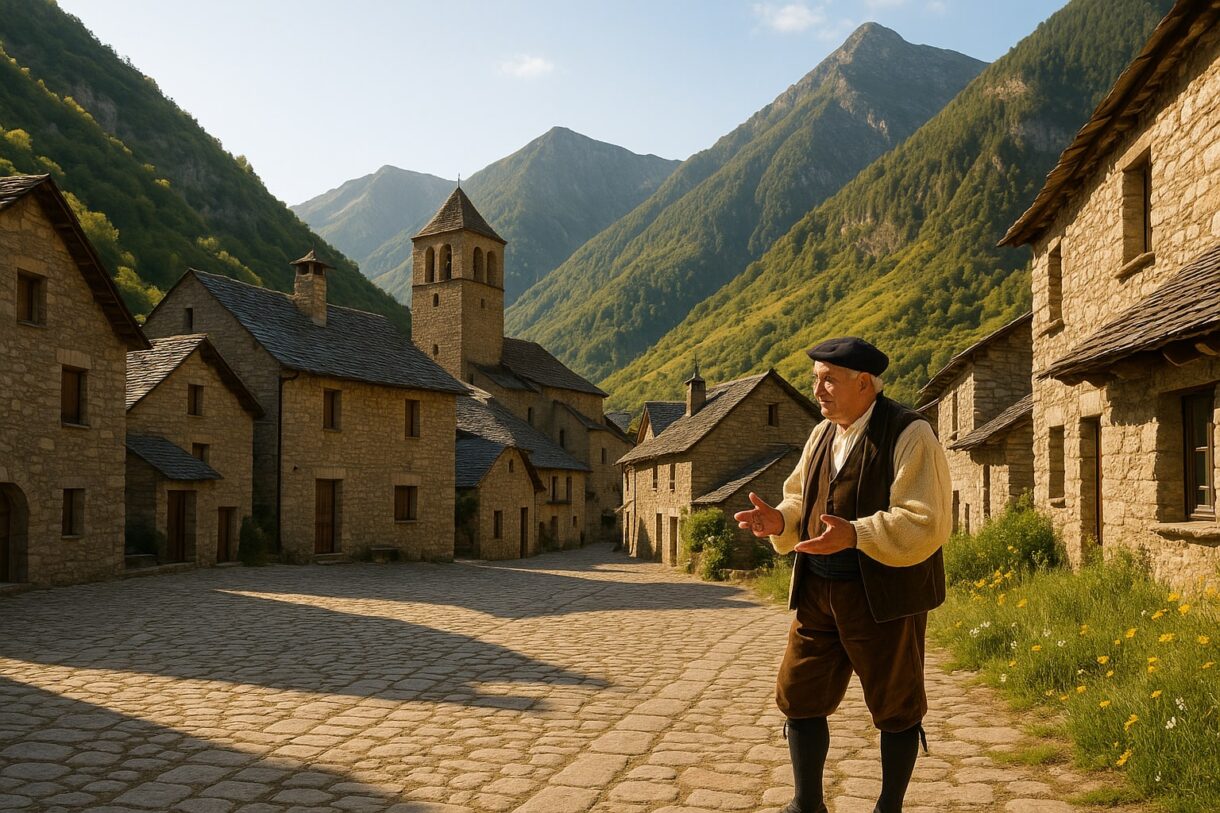
If what you’re looking for is a corner of the Pyrenees where the language, the architecture and the landscape still speak the same tongue they did four centuries ago, the valleys of Ansó and Hecho are the most honest answer the Aragonese Pyrenees can give you. They lie at the northwestern edge of the province of Huesca, bordering Navarre and the French frontier, and they preserve something that has survived with almost unmatched stubbornness anywhere else in Spain: a distinct variety of Aragonese, Cheso, which can still be heard in the bars of Hecho among neighbours over sixty.
This guide is for you if you plan to spend between two and four days in the area, want to understand what you are seeing (and hearing), and prefer a journey through stone villages, shepherds’ cheeses and forest tracks rather than one of ski lifts and resorts. It is not a destination for a quick weekend trip from Madrid or Barcelona: getting there takes time, and that is part of the reason it has remained intact.
Quick facts about the valleys
| Detail | Value |
|---|---|
| Location | Jacetania, northwest Huesca (Aragon) |
| Rivers | Veral (Ansó) and Aragón Subordán (Hecho) |
| Village altitude | Ansó 860 m, Hecho 833 m |
| Population | Ansó ~430, Hecho ~930 |
| Main access | A-176 from Puente la Reina de Jaca |
| Own language | Cheso, a variety of Aragonese |
| Best time | June–September and first snowfall |
Exactly where Ansó and Hecho are
The two valleys run parallel from north to south, separated by the Sierra de los Dos Ríos. Ansó lies to the west, watered by the Veral river, and Hecho (Echo in local spelling) to the east, along the Aragón Subordán. From Jaca it is roughly 50 km to Hecho and about 65 to Ansó via the A-176, with the turn-off at Puente la Reina de Jaca. Between one village and the other, by road, allow about 25–30 minutes: there is no direct shortcut except forest tracks.
To the north, both valleys end at the border with France: Hecho closes at the Selva de Oza and the Olibón cirque; Ansó at Zuriza and the Alanos. They are high-mountain headwaters, with summits above 2,300 metres, but the valley floors are gentle and easy to traverse.
What Cheso is and why it is still alive
Cheso or fabla chesa is the variety of Aragonese spoken in the Hecho valley. It is not a dialect of Castilian nor a folkloric curiosity: it belongs to the Aragonese family, a Romance language with its own medieval documentation, now classified by UNESCO as “endangered”. In Ansó its own variant, Ansotano, was spoken, though today it is practically lost as a language of everyday use.
Cheso’s survival has concrete explanations: geographic isolation until well into the twentieth century, a stable pastoral community, and the work of local authors such as Veremundo Méndez Coarasa, a twentieth-century Cheso poet whose work is still read in the valley’s schools. Today a few dozen older people speak it fluently, but there are courses, publications and a neighbourhood movement to pass it on.
If you go to a bar in Hecho on a Sunday morning and hear two gentlemen say “¿qué fas?” instead of “¿qué haces?”, that is Cheso. Do not expect official bilingual signs as in other communities: its presence is more domestic than institutional.
Hecho: the village, the monastery and the Selva de Oza
Hecho is the most lively core of the two valleys. Stone houses with slate roofs, conical chimneys (the espantabrujas, or “witch-scarers”) and wooden balconies. The town centre takes a good hour to walk; it is worth wandering along Calle Mayor and down to the bridge over the Aragón Subordán.
Two kilometres north is Siresa, home to the Monastery of San Pedro, one of the oldest buildings in the Aragonese Pyrenees. Founded in the 9th century, it was one of the cultural centres of the emerging kingdom of Aragon: according to tradition, Alfonso I the Battler was educated here. The current church is Romanesque, austere, with a very tall nave that surprises on entering. Admission is around €2–3 and opening hours change with the season; it is advisable to call Hecho town hall before going.
Following the road 15 km further north you reach the Selva de Oza, a beech-and-fir forest between limestone walls. It is the base for walks to the Acherito ibón (high mountain lake), to the Guarrinza plains, or to the southern mouth of the alternative Camino de Santiago via the Somport. The road is paved up to a car park where access is charged in July and August (check beforehand; it usually costs around €5 per vehicle).
Ansó: historic quarter and traditional dress
Ansó is smaller and quieter. Its old town was declared a Historic-Artistic Ensemble in 1983 and it shows: steep stone streets, carved lintels bearing the year of construction (many from the 16th and 17th centuries), and the parish church of San Pedro, dating from the 16th century, with a collection of sacred art that includes Gothic carvings and a small ethnological museum attached.
The Ansotano dress is probably the best documented in the Pyrenees. It is displayed on the last Sunday of August at the Traditional Dress Day, when the village women take it out of their chests: green basquiña, woollen saya, starched white coif. It is not a tourist re-enactment but a festival for the locals, which you can attend with respect.
North of the village, the road climbs to Zuriza (about 15 km), starting point for routes to the Ansabère ibones, to Petrechema or to the Taxeras gorge. There is a campsite and a mountain refuge; in winter the road may close because of snow.
What to eat: Ansó cheese, migas and recao
The cooking of both valleys is pastoral, pot-based and mountain-style. Dishes to look for:
- Ansó cheese: sheep’s cheese, cured, with its own locally recognised designation. It is sold in artisan dairies in the village itself.
- Migas a la pastora: with grapes, chorizo and sometimes egg.
- Recao de Hecho: a hearty stew of beans, potatoes and rice, designed for after a day in the hills.
- Ternasco de Aragón (PGI): young lamb, roasted or grilled.
- Trout from the Veral or the Aragón Subordán: Navarrese-style, with ham.
In Hecho, Gaby-Casa Blasquico has for decades served valley cooking with local produce; it is a reference point for those who know the area, not an improvised recommendation. In Ansó, the bars on the square serve honest portions and local cheese at village prices (set plate €12–16, set lunch menu when available €15–20).
Hiking: three routes with their own names
The western valleys of Huesca have a very complete network of marked trails. Three routes to get a feel for the terrain:
| Route | Starting point | Return duration | Difficulty |
|---|---|---|---|
| Acherito ibón | Selva de Oza (Hecho) | 4–5 h | Moderate |
| Foz de Biniés | Berdún / Biniés | 2–3 h | Easy |
| Ansabère ibones | Zuriza (Ansó) | 6–7 h | Moderate–hard |
The Foz de Biniés, a gorge of the Veral between Ansó and Berdún, is walked almost on the flat and is a good choice for days of high fog or for going with children. The two lake routes require mountain footwear, water and checking the forecast: afternoon storms in summer are common.
Getting there and getting around
By car from Zaragoza it takes about 2 h 15 min to Hecho (A-23 to Jaca, then A-176). From Pamplona, around 1 h 45 min. From Madrid, allow 5–6 h.
By public transport things get complicated. There are Alosa buses from Jaca to Hecho and Ansó, with very limited frequencies (one or two a day on weekdays, fewer at weekends). Getting between the two valleys without a car is practically unfeasible: hiring a vehicle in Jaca or Pamplona is the realistic option.
The nearest airport in operation is Zaragoza; Pamplona also works well if you are coming from the north. For a comparison with another nearby Pyrenean area where medieval heritage is the focus, see this contrast between Aínsa and Roda de Isábena.
Where to sleep and how much it costs
Both villages offer rural guesthouses, hostels and a few small hotels. Indicative ranges for 2026, double room:
- Rural guesthouse in Hecho or Ansó: €65–95/night in mid-season, €90–130 in August and long weekends.
- Family hostel: €50–75/night.
- Campsite (Zuriza, Selva de Oza): pitch between €20–30 with tent and vehicle.
Book in advance for the last week of August (festivities and the Traditional Dress Day in Ansó) and for the Pilar and All Saints’ long weekends. In November and on weekdays in May you will find availability and noticeably better prices.
When to go and what to avoid
June and September are the most balanced months: mild temperatures, green meadows, few people. July and August concentrate the activity: festivities, families, Selva de Oza car parks at capacity. October brings the beech woods in colour. Winter is quiet but with high roads closed by snow and reduced services.
Common mistakes:
- Trying to see both valleys in one day. You can, but you will understand neither.
- Driving up to Zuriza or the Selva de Oza without filling up: there are no petrol stations in the valleys.
- Relying on mobile coverage. Much of the valleys has no signal.
- Looking for restaurants at 16:00 out of season: kitchens close earlier than on the coast.
Frequently asked questions
Where is Cheso spoken? It is spoken in the Hecho valley (Huesca), especially in the villages of Hecho and Siresa. The number of active speakers is small, but there are local initiatives to teach it.
What is fabla chesa? It is the variety of Aragonese specific to the Hecho valley. It belongs to the same family as general Aragonese, with its own vocabulary and pronunciation. It has written literature, notably the work of Veremundo Méndez Coarasa.
How many days do I need to see Ansó and Hecho? With three full days you can see both old towns, Siresa, the Selva de Oza and do one mountain route. To include Zuriza, the lakes and the gorges, four days is more comfortable.
Can I go with children? Yes. The Foz de Biniés, walks in the Selva de Oza and the centre of Ansó all work well. For lake routes, better from 8–10 years old and with suitable footwear.
Are there cash machines and petrol stations in the valleys? Cash machines in Hecho and Ansó, yes. A working petrol station in Puente la Reina de Jaca; inside the valleys the offer is very limited. Fill up before going up.
Is it worth going in winter? If you like quiet villages and snow, yes. But many restaurants close on weekdays, the high roads may be cut off and hiking is reduced to valley-floor routes.
If you have to choose one concrete recommendation: book two nights in Hecho on a weekday in June or September, spend an afternoon in Siresa and a full day in the Selva de Oza, and cross to Ansó on the second day to eat valley cheese and attend, if you coincide, any neighbourhood activity. That is where Cheso can still be heard for real, at the next table, without a microphone.
Customs and Traditions Places of Interest Leisure and Culture #lengua y cultura #Pirineo #pueblos con encanto #senderismo #Turismo rural #Valles
 Don't get fooled: plan your trip well and avoid these scams on your holidays
 Central Macedonia, the destination Spaniards have discovered to fall in love with Greece
 Summer in Brussels: flowers, festivals and typical gastronomy
Comentarios cerrados