Trevélez ham, cured at 1,500 metres, and the truth about its PGI
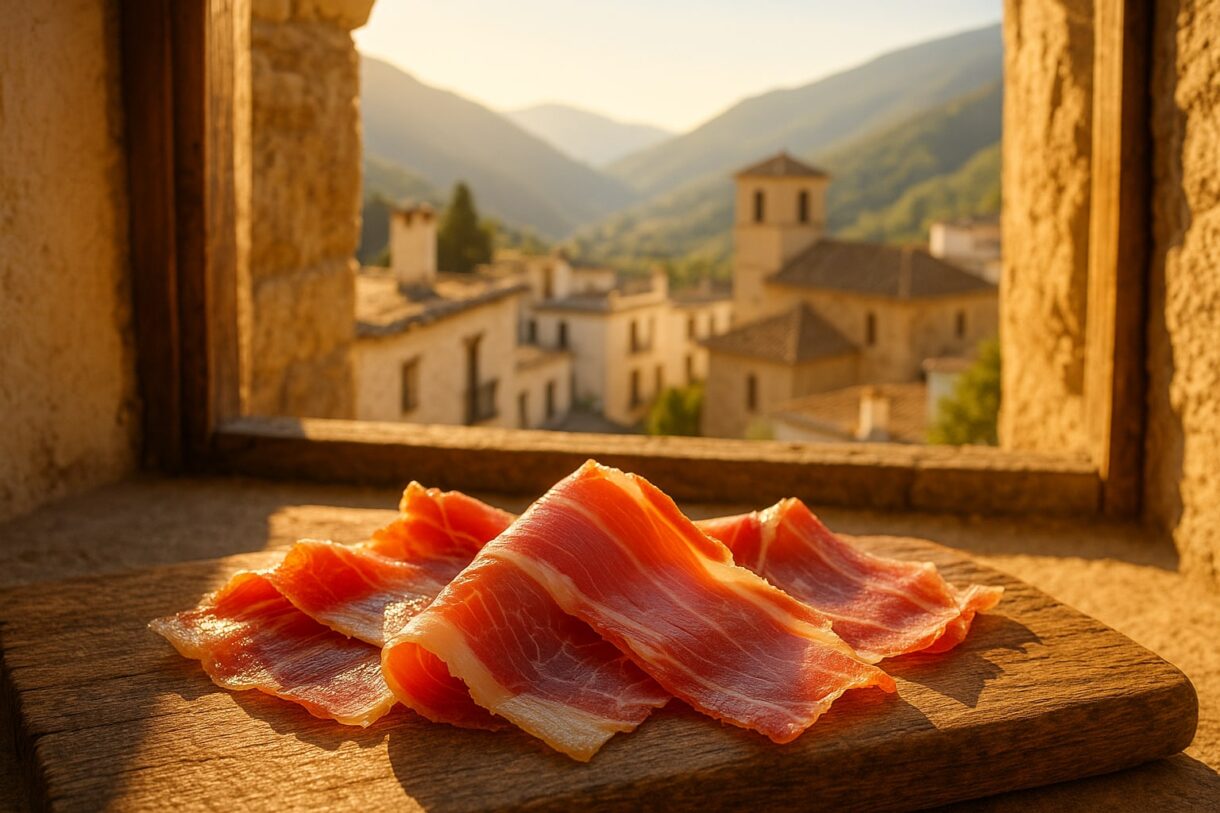
If you’ve come here wondering whether Trevélez PGI ham is Iberian, the short answer is: no, as a general rule, it isn’t. The Protected Geographical Indication that covers Trevélez ham protects the place and the curing method —municipalities in the Granada Alpujarra located above 1,200 metres— not the breed of the animal or its origin. Most pieces bearing the blue, red or black Trevélez seal come from white pig (crosses of Landrace, Large White and Duroc), not from Iberian pig.
This article is useful if you’re thinking of buying ham in Trevélez, if you’re going up to the village and want to understand what you’re asking for at the counter, or if you’ve simply been sold a piece “from Trevélez” and want to know what you’re eating. Let’s take it step by step, using the Regulatory Council’s specification and the European Regulation as reference.
What exactly the PGI Jamón de Trevélez is
The Protected Geographical Indication Jamón de Trevélez was recognised by the European Union in 2005 (EC Regulation 1855/2005), after decades of local reputation and an earlier protection at Andalusian regional level. It is one of the few Spanish meat PGIs focused exclusively on the curing process in a specific microclimate.
Unlike a Protected Designation of Origin (PDO), which requires that raw material and processing come from the same area, a PGI only requires that at least one of the stages —production, processing or preparation— take place in the delimited territory. In the case of Trevélez, the protected stage is curing.
In practice, this means that a ham may come from a pig raised in Segovia, Teruel or Lleida, and be legitimately “Trevélez Jamón PGI” as long as it is cured in one of the authorised municipalities and meets the specification.
The covered municipalities and the 1,200-metre rule
The Regulatory Council’s specification delimits the curing area to municipalities of the Granada Alpujarra located above 1,200 metres of altitude. Among them are Trevélez, Juviles, Bérchules, Busquístar, Pórtugos, Cástaras, Lobras and Capileira, among others.
Trevélez, at roughly 1,476 metres above sea level in its lower part and exceeding 1,600 in the upper neighbourhood, is the historic core and the one that gives the PGI its name. This is no coincidence: the combination of dry air, low winter temperatures, cool summers and stable relative humidity produces a slow, even cure without the need for artificial chambers.
| Data | Value |
|---|---|
| PGI recognition | EC Regulation 1855/2005 |
| Minimum curing altitude | 1,200 m |
| Altitude of Trevélez | 1,476 m (lower core) |
| Predominant breed | White pig (Landrace, Large White, Duroc) |
| Minimum curing | 14 months (blue seal) |
| Usual maximum curing | 20+ months (black seal) |
Why the pig is white and not Iberian
This is the most frequent confusion, fuelled by shops that play on the ambiguity. White Trevélez ham comes almost always from white-coated pigs, the same ones that supply the serrano ham industry throughout Spain. They are crosses selected for meat yield and fat marbling.
The Iberian pig, with its specific genetics and acorn-based diet in the dehesa, belongs to a different regulatory world: the PDO Jabugo, the PDO Guijuelo, the PDO Dehesa de Extremadura or the PDO Los Pedroches. A pure acorn-fed Iberian ham is rarely cured in the Alpujarra; its reference habitat is the Extremaduran and western Andalusian dehesa.
There are pieces of Iberian pig cured in Trevélez, but they do not fall under the PGI umbrella: the Indication covers the traditional serrano method applied to white pig. If you see “Iberian from Trevélez” on a label, read the fine print: it is a different product.
The coloured seals: what each one guarantees
The Regulatory Council uses a system of three-colour seals according to the minimum curing time. It is the quickest way to know which piece you have in front of you:
| Seal | Minimum curing | Flavour profile |
|---|---|---|
| Blue (cellar) | 14 months | Mild, less intense, lighter fat |
| Red (reserve) | 17 months | Balanced, more developed aromas |
| Black (grand reserve) | 20 months or more | Drier, concentrated flavour, cured marbling |
Each certified piece carries, besides the numbered seal, the Regulatory Council’s stamp and an identifying tag or label. If you see no seal, it is not PGI, even if it was cured in the village.
How it is cured: what the drying houses do and what the air does
Production follows the traditional serrano method: salting in sea salt (roughly one day per kilo of piece), washing, resting in a cold chamber, and transfer to natural drying rooms with large windows. Here lies the key: the master ham makers open and close the windows according to the wind, humidity and time of day. The dry air of the Sierra Nevada does the rest.
No nitrites or added preservatives beyond salt are used. The curing is entirely natural, without climate-controlled chambers, which explains the seasonal variations between batches and the slowness of the process.
Trevélez village: how to get there and what you’ll find
Trevélez lies on the southern slope of the Sierra Nevada, in the Granada Alpujarra region, province of Granada. From the capital it takes about 1 hour and 45 minutes by car via the A-44 and A-348, with a final stretch of mountain road with tight bends. There is no train. Buses from the company Alsa connect Granada with Trevélez once or twice a day; it is advisable to check timetables before going as services are limited.
The village is divided into three terraced neighbourhoods —Lower, Middle and Upper— linked by steep streets of whitewashed houses with flat launa roofs, typical of Alpujarran Berber architecture. The drying houses are concentrated in the Upper neighbourhood and on the outskirts, taking advantage of the greater altitude.
If you’re touring the area, it makes complete sense to combine your visit with the villages of the Poqueira Gorge: I cover this in detail in this guide to visiting Pampaneira, Bubión and Capileira without the usual clichés.
Where to buy ham in Trevélez without overpaying
In the village there are several historic ham-curing houses with a shop open to the public: Jamones Jesús Nevado, Jamones Cano, Jamones Castaño and Jamones González Byass among the best known. All work with PGI and sell whole, half, boneless or vacuum-sliced pieces.
Indicative price ranges at the end of 2026 (white pig, PGI):
- Whole piece blue seal (14 months): 9-13 €/kg
- Whole piece red seal (17 months): 13-17 €/kg
- Whole piece black seal (20+ months): 17-22 €/kg
- Sliced vacuum packs: 4-7 € per 100 g
Buying in the village doesn’t always work out cheaper than in a good delicatessen in Granada, but it lets you see the drying room, choose your piece and talk to the person who cured it. If you go by car, plan the weight carefully: a whole piece weighs around 7-8 kilos.
What to eat in Trevélez besides ham
The village has a robust mountain cuisine. In the restaurants of the Middle and Lower neighbourhoods you’ll find Alpujarran dish (lomo de orza, morcilla, chorizo, potatoes “a lo pobre”, fried egg and, of course, ham), migas serranas, choto al ajillo and Trevélez trout, from the river that gives the village its name. To sample local produce without breaking the bank, a set lunch menu costs around 14-18 €.
Alpujarra goat’s cheese and the wines of the Contraviesa (the neighbouring sierra to the south) complete the table. Ask for a costa or costa-contraviesa wine, light high-altitude whites and rosés that pair well with ham.
When to go up: seasons and climate
Trevélez works all year round, but each season has its own character:
- Spring (April-June): mild temperatures, snowmelt, a good time for walking.
- Summer (July-August): cool because of the altitude (highs of 25-28 °C when Granada is sweltering), more visitors.
- Autumn (September-October): golden light, fewer people, the drying houses working at full capacity.
- Winter (November-March): real cold, frequent snow, the road sometimes difficult. It is the key season for curing.
On 5 August the feast of Our Lady of the Snows, the village’s patron saint, is celebrated with a pilgrimage up to a sanctuary in the high mountains. It is the busiest date of the year.
Common mistakes when buying Trevélez ham
- Confusing “serrano from the Alpujarra” with Trevélez PGI: if it doesn’t carry the numbered Regulatory Council seal, it is not PGI.
- Asking for “Iberian from Trevélez” expecting acorn-fed: no such thing exists within the PGI; the protection covers white pig.
- Buying the cheapest piece without asking its curing time: a freshly completed blue seal tastes very different from one cured for 20 months.
- Not asking about the cut: if you don’t have a ham stand at home, ask for boneless or vacuum-sliced; a whole piece poorly stored will spoil.
- Going up in August without booking: the village has few lodgings and they fill up.
Frequently asked questions
Is Trevélez ham Iberian? No. The PGI covers hams from white pig cured in the high Alpujarra. There may be Iberian pieces cured in the village, but they fall outside the Protected Geographical Indication.
What is the difference between blue, red and black seals? The minimum curing time: 14, 17 and 20+ months respectively. The longer the curing, the more intensity, the less water in the piece and the higher the price.
How much does a Trevélez PGI ham cost in 2026? A whole piece ranges from 9 to 22 €/kg depending on the seal. Vacuum-sliced, between 4 and 7 € per 100 g. Indicative prices subject to change.
Can I visit a drying house? Several ham-curing houses in the village offer guided visits, sometimes with a tasting included. It is advisable to call ahead, especially outside summer, as not all have fixed public opening hours.
How do I get to Trevélez without a car? There are Alsa buses from Granada, with one or two daily services and a journey of about three hours. Check timetables before planning; at weekends services are reduced.
Is it worth going up just for the ham? If you only want to buy, no: you’ll find it in specialist delis in Granada or by mail order. If you want to understand the product, see the drying houses open onto the valley and combine it with the Alpujarra route, yes.
If you go up, do it with time to spend a night: the village changes once the midday buses leave, and the afternoon cold in the Upper neighbourhood —with the whole valley below— explains, better than any label, why here the ham is cured the way it is.
Customs and Traditions Gastronomy #Alpujarra #curación de jamón #gastronomía #IGP #jamón de Trevélez #productos típicos


 Don't get fooled: plan your trip well and avoid these scams on your holidays
 Central Macedonia, the destination Spaniards have discovered to fall in love with Greece
 Summer in Brussels: flowers, festivals and typical gastronomy
Comentarios cerrados