Stockholm or Copenhagen: which to choose for a first visit to Scandinavia
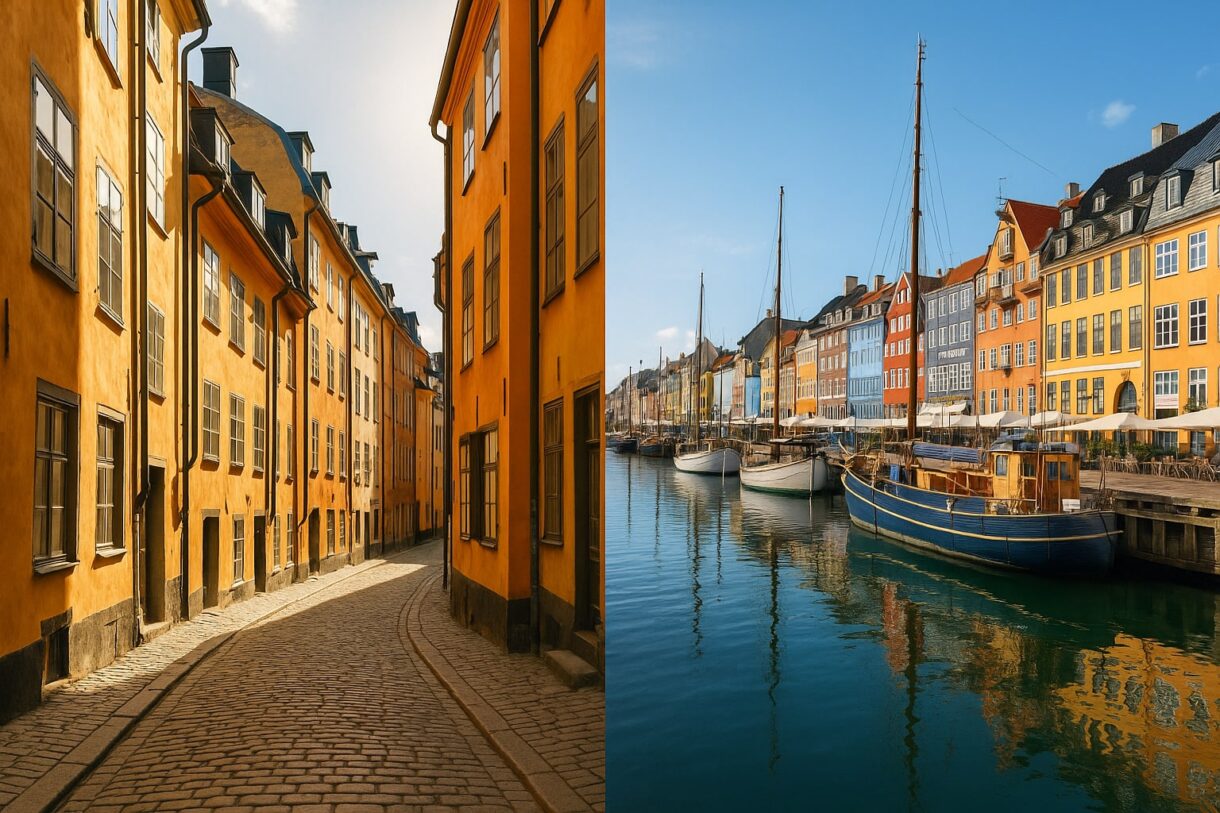
The short answer: which to choose if you can only see one
If it’s your first trip to Scandinavia and you have three or four days, Copenhagen is the better fit for most people. It’s more compact, you can cover it on foot or by bike, English works everywhere, and the learning curve—how to get around, where to eat, how much to pay—is gentler. Stockholm needs more time because it is spread across islands and because its charm reveals itself slowly: the boats out to the archipelago, the neighborhoods north of the center, the winter silence of Gamla Stan at dawn.
That said, Stockholm wins if you go in spring or summer and you’re drawn to water landscapes, purer Nordic design and a slightly less touristy city. Copenhagen is clearly experiencing mass tourism since it entered every food list; Stockholm can still be visited without dodging queues on every corner.
Quick comparison: Stockholm vs. Copenhagen
| Detail | Stockholm | Copenhagen |
|---|---|---|
| Recommended days for a first visit | 4-5 | 3-4 |
| Currency | Swedish krona (SEK) | Danish krone (DKK) |
| Coffee at a café | 35-50 SEK (€3-4.5) | 35-50 DKK (€4.5-6.5) |
| Casual dinner per person | 200-350 SEK | 200-350 DKK |
| Airport to city center transport | Arlanda Express 20 min / bus 45 min | Metro M2 15 min |
| Useful language | English (very high level) | English (very high level) |
| Best time | May-September | May-September, December for the markets |
Why compare these two and not include Oslo
Oslo is expensive even by Scandinavian standards, has less urban life than the other two, and its main attraction—the fjords—is hours away. For a first introduction to the region, the Stockholm-Copenhagen axis covers the essentials: two historic capitals, two living monarchies, two distinct models of how to understand Nordic urban life. Reykjavik plays in a different logistical league, and Helsinki, though interesting, has less of a “postcard” appeal for someone arriving for the first time.
Context: two capitals that are less alike than you think
Copenhagen is port, flatland and bicycles. Founded in the 12th century as a fishing outpost, it grew facing the sea and trading with the Baltic. Today it keeps that horizontal profile: few tall buildings, canals crossed on foot, and a street life surprisingly Mediterranean for its latitude.
Stockholm is archipelago. Fourteen islands joined by bridges, water everywhere, and a history that mixes the power of the Vasa dynasty in the 16th century with 20th-century industrial design. More vertical, colder in every sense, more theatrical. If Copenhagen is conversation on a café terrace, Stockholm is a long, silent walk along the water.
Climate and the best time to go
Both cities share the same logic: dark, long winters and bright, short summers. The comfortable window runs from mid-May to mid-September.
- May-June: very long days (up to 18 hours of daylight in Stockholm in June), temperatures of 15-22 ºC, less tourism than in July.
- July-August: the true high season. High accommodation prices, reservations required.
- October-March: darkness from 15:30-16:00, damp cold (0-5 ºC on average). Copenhagen wins in December thanks to the Christmas markets at Tivoli and Nyhavn; Stockholm has its snowy charm, but demands serious warm clothing.
How much each city costs: a realistic daily budget
Both are among the most expensive places in Europe, but they’re not identical. Copenhagen is 10-15% more expensive for dining out; Stockholm offsets this with somewhat higher accommodation prices in the center.
| Item | Stockholm (day/person) | Copenhagen (day/person) |
|---|---|---|
| Hostel / dormitory | 350-500 SEK | 300-450 DKK |
| Mid-range central hotel | 1,200-2,000 SEK | 1,100-1,800 DKK |
| Casual lunch | 120-180 SEK | 130-200 DKK |
| Restaurant dinner | 300-500 SEK | 350-550 DKK |
| 24h transport | 175 SEK | 90 DKK |
| Average traveler total | 900-1,400 SEK (€80-125) | 850-1,400 DKK (€115-190) |
Indicative figures for 2026; it’s advisable to check transport fares on the official websites of SL (Stockholm) and DOT (Copenhagen) before you go.
What to see in each: the unmissable highlights
In Stockholm, the old town Gamla Stan can be walked in a morning, but the museum that justifies the trip is the Vasa: a 17th-century galleon raised whole from the bottom of the harbor. Next to it, Skansen recreates rural Swedish life in the open air. If you’re into design, the Nationalmuseum and Fotografiska are each worth the ticket. Set aside half a day for a boat to the archipelago: Vaxholm or Fjäderholmarna are easy to reach without hassle.
In Copenhagen, the basic circuit is Nyhavn, Amalienborg, Rosenborg and the Tivoli Gardens. The Little Mermaid disappoints almost everyone; it’s visited out of inertia. The interesting parts are in Christianshavn and the free community of Christiania (photos prohibited in certain areas, please respect that). For art, the SMK (Statens Museum for Kunst) and the Louisiana, 35 minutes by train toward Humlebæk, are two levels above the European average.
Where to stay: neighborhoods with character
Stockholm:
- Norrmalm: central, practical, dull at night.
- Södermalm: the liveliest neighborhood, with cafés and Swedish design shops. The choice if it’s your second visit or you want atmosphere.
- Östermalm: elegant, expensive, good restaurants.
- Gamla Stan: pretty but touristy and with little real life after 20:00.
Copenhagen:
- Indre By (center): walkable to everything.
- Vesterbro: a former working-class district turned trendy, the equivalent of Stockholm’s Södermalm.
- Nørrebro: multicultural, good food scene, less postcard-like.
- Christianshavn: canals, bicycles, perfect for staying 3-4 days.
Food: smørrebrød vs. köttbullar
Copenhagen has pushed Nordic cuisine into another dimension since Noma, but what matters for a first trip is the everyday: smørrebrød (rye bread with herring, salmon, egg or roast beef) at places like Aamanns or Schønnemann, a street-cart hot dog from a pølsevogn (30-45 DKK), a coffee with a kanelsnegl (cinnamon snail).
Stockholm defends its köttbullar (meatballs with mashed potatoes and lingonberry sauce), gravlax (cured salmon) and the tradition of fika: a coffee-and-pastry break, usually with a kanelbulle, around mid-morning or mid-afternoon. The Östermalms Saluhall market is the best way to try several things without making an expensive mistake.
Getting around within each city
Copenhagen is done by bicycle. There are more bikes than cars, bike lanes everywhere, and rentals from around 100-150 DKK a day. The metro runs 24 hours and connects the airport to the center in 15 minutes for 36 DKK.
Stockholm requires public transport because of the distances between islands. The SL Access Card gives access to the metro, buses and local ferries. The metro (Tunnelbana) is also worth visiting in itself: several stations on the blue line have artistic installations that deserve a stop.
Language, payments and practical details
Both cities function practically cashless. Bring a card with contactless payment and a backup. English is universal in hospitality, transport and retail; learning “tak” (thank you in Danish) and “tack” (in Swedish) is enough to break the ice.
If you’re coming from another European trip, see how we handle neighborhoods and budget in Lisbon in four days: the planning logic is similar, even if the numbers change.
Verdict by traveler profile
| Profile | Recommended choice |
|---|---|
| First time, 3-4 days | Copenhagen |
| First time, 5-7 days | Stockholm or a combination |
| Couple, short getaway | Copenhagen |
| Family with children | Copenhagen (Tivoli, bikes) |
| Interest in design and art | Stockholm |
| Winter trip | Copenhagen (markets) |
| Tighter budget | Stockholm (slightly) |
Combining both in one trip
It’s feasible and many people do it. The direct train Copenhagen-Stockholm takes about 5 hours (from 400-800 SEK if you book in advance on SJ.se). Flying between them starts at €40-80 with SAS or Norwegian, with a 1h10 journey. For a week, the split that works is 3 nights in Copenhagen + 4 nights in Stockholm, arriving through one airport and leaving through the other so you don’t backtrack.
Frequently asked questions
Is Scandinavia really as expensive as they say? Yes, especially for dining out and alcohol. A half-liter beer costs around 70-90 SEK/DKK (€6-9). You can keep costs down by eating at markets, taking advantage of lunch menus, and shopping at supermarkets like Lidl or Netto.
Do I need to book museums in advance? In Stockholm, it’s wise to book the Vasa online in summer. In Copenhagen, Tivoli and the Louisiana can be bought the same day except on high-season weekends.
Can I pay in euros? Not usually. Both countries keep their own currencies and most shops don’t accept euros. Pay by card and avoid exchanging cash at the airport.
Is it safe to move around at night? Yes, both cities are among the safest in Europe. Take basic precautions in nightlife areas (Vesterbro in Copenhagen, the neighborhoods south of Södermalm in Stockholm).
Is it worth going in December? Copenhagen, yes: Tivoli with Christmas lights and the markets at Nyhavn make the cold worthwhile. Stockholm is harsher in winter, with few hours of daylight, although snowy Gamla Stan has its appeal if you enjoy walking well wrapped up.
How many days to see both? With 7 nights you can cover both without rushing. Fewer than 6 nights forces you to choose one.
Final recommendation
If it’s your first trip to Scandinavia, you have four days, and you’re going between May and September, fly to Copenhagen, stay in Vesterbro or Christianshavn, rent a bike on the second day and set aside an afternoon for the Louisiana. If you have a full week, add Stockholm by train and devote at least two full days to the archipelago. It’s the combination that leaves the fewest regrets.
Tips Places of Interest #ciudades #comparativa destinos #consejos de viaje #Copenhague #Estocolmo


 Don't get fooled: plan your trip well and avoid these scams on your holidays
 Central Macedonia, the destination Spaniards have discovered to fall in love with Greece
 Summer in Brussels: flowers, festivals and typical gastronomy
Comentarios cerrados