Vejer de la Frontera: the white village of Cádiz where bluefin tuna and Andalusian pastry come together
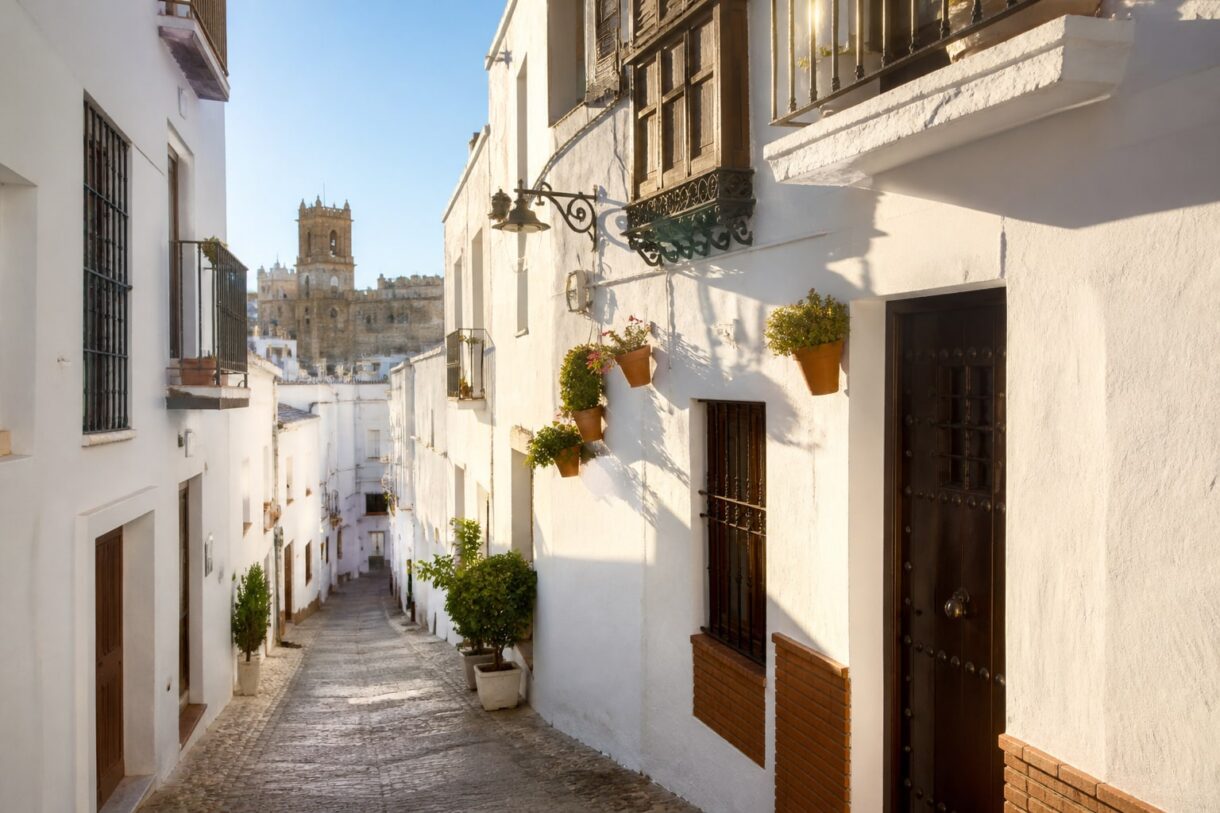
If you’re torn between several white villages of Cádiz for a first visit and you’re looking for more than whitewashed façades, Vejer de la Frontera settles the question: in one small old town it brings together two legacies that remain alive every day, the Phoenician bluefin tuna almadraba and the pastry tradition inherited from Al-Ándalus. In two nights you have time to take it in without rushing.
This article is for you if you travel as a couple, with friends or as a family, enjoy walking without hurry, eating well and understanding what you see. It is not a resort or adventure destination: it is culture, food and a very particular light over the Cádiz countryside.
Vejer at a glance: quick facts
Before going into detail, a summary of the facts that usually decide the trip.
| Detail | Value |
|---|---|
| Location | Province of Cádiz, La Janda comarca |
| Altitude | About 190 m above sea level |
| Distance to Cádiz city | Approx. 50 km |
| Distance to the beach (El Palmar / Zahora) | 10-12 km |
| Designations | Historic-Artistic Ensemble since 1976 |
| Almadraba season | From April to June, approx. |
| Best time to visit | Spring and early autumn |
| Recommended stay | 2 nights (1 for the village, 1 for the surroundings) |
Why Vejer and not another white village
The white villages of Cádiz share an aesthetic —lime, tile, wrought iron— but tell different stories. Vejer perches on a hill overlooking the countryside and, on clear days, the Strait of Gibraltar can be seen. It was a Muslim stronghold until 1264 and preserves a recognizable walled enclosure, with four gates of Almohad origin.
What sets it apart from Arcos, Grazalema or the nearby Setenil de las Bodegas is the double connection with the sea and with Andalusian memory. Ten minutes by car are the beaches of Barbate and Zahara de los Atunes, where the almadraba has been practiced since Phoenician times; in the village, the workshops still make amarguillos and almond tortas using recipes that come from the cuisine of Al-Ándalus.
What to see in Vejer de la Frontera without rushing
The old town can be walked in half a day, but it deserves two strolls: one in full daylight and another at sunset, when the lime changes color.
- Plaza de España: the social heart of the town, with the Sevillian tile fountain from the 1930s and the Town Hall. A good starting point.
- Castle of Vejer: of Almohad origin, with a courtyard and views of the Atlantic on clear days. Free or symbolic entry; opening hours vary, it is advisable to check at the tourist office.
- Church of the Divino Salvador: Gothic-Mudéjar, built over a former mosque. Notice the mix of styles in the interior.
- Arco de la Segur, Puerta Cerrada, Arco de Sancho IV and Puerta de la Villa: the four entrances to the medina. Walking between them is the best way to read the town’s urban layout.
- Judería quarter: white, narrow streets that slope down toward the southern wall. Easy photography, no crowds if you visit outside August.
- Mirador de la Cobijada: the essential viewpoint over the La Janda countryside.
The cobijado: a custom that nearly disappeared
Until the mid-20th century, many women of Vejer went out into the street cobijadas: a black outfit, heir to the Muslim veil, which showed only one eye. The dictatorship banned it in the 1930s for being confused with concealing one’s identity, and today it survives as a ceremonial dress, visible above all during Holy Week and in August, during the patron saint festivities of the Virgen de la Oliva, patroness of Vejer. In the village you will find sculptures and constant references to this figure; it is not recycled folklore, it is part of local identity.
Bluefin tuna from the almadraba: where to try it and when
The almadraba is a fishing art of Phoenician origin: a labyrinth of nets set off the coast to catch bluefin tuna (Thunnus thynnus) when it enters the Mediterranean to spawn. In Barbate, Zahara de los Atunes, Conil and Tarifa it is still practiced, under regulated quotas. The season runs, approximately, from April to June.
If you visit in those months, the tuna reaches the restaurants of Vejer at its best. Ask for the cuts by name:
- Tarantelo: between the belly and the loin, juicy, to cook with onions or on the griddle.
- Mormo: near the head, tender. Ideal as tataki.
- Ventresca: the fattiest part, for grilling over embers.
- Morrillo: small, very flavorful, usually grilled.
- Facera and galete: less known cuts, stewed.
Outside the season, atún de ijar (frozen in brine) and mojama are eaten, the loin cured in the air, which in the area is served in thin slices with olive oil and almonds. If you have never tried mojama from Barbate, now is a good time.
Andalusian pastry: amarguillos, alfajores and tortas
The traditional pastry of Vejer draws directly from the Andalusian recipe book: almond, honey, aniseed, sesame, cinnamon. Among the things you should not leave without trying:
- Amarguillos: small bites of bitter almond, egg white and sugar. Texture between meringue and marzipan.
- Almond tortas: thin, crisp, very aromatic.
- Alfajores: with honey, almond and spices; nothing like the Latin American alfajor.
- Piñonate: fried dough sweet soaked in honey, typical of Christmas.
- Pan de Cádiz: marzipan dough filled with egg yolk and sweet potato.
You will find workshops and sweet shops around the old town. Ask for those that have been open for decades; many also supply nearby convents.

Where to stay: inside or outside the walls
The main decision is whether you sleep in the old town or in a country house in the surroundings.
| Option | Best for | Approximate price (double night) |
|---|---|---|
| Boutique hotel inside the walls | Couples, short stay, no car | 90-160 € |
| Country house in the La Janda countryside | Families or groups, with a car | 110-200 € |
| Holiday apartment in the old town | Small groups, self-catering | 80-140 € |
| Accommodation in El Palmar or Zahora | Beach priority | 70-150 € |
Inside the walls you get nightlife and mornings with lime and bells; you lose convenience with the car (pedestrian streets, restricted loading and unloading). Outside, you gain tranquility and price, but you depend on the vehicle to dine in the village.
How to get there and how to get around
Vejer has no train station. The usual ways to arrive:
- By car: via the A-48 (former N-340) from Cádiz (about 50 km, 45 min) or from Málaga (via the A-7 and A-381, about 2 h). It is the most convenient option if you want to combine village, beach and almadraba.
- By bus: Comes connects Vejer with Cádiz, Barbate, Conil and Tarifa several times a day. Journey from Cádiz, around 1 h 15.
- Airports: Jerez (about 80 km) or Seville (about 160 km). Málaga is farther but usually has more flights.
Within the village you travel on foot. There are car parks at the lower part (La Plazuela and access roads) and a public lift that saves the climb. For the surroundings (beaches of El Palmar, Zahara, Bolonia, the Retín mountains) you need a car or taxi.
When to go: seasons, heat and crowds
| Season | What to expect |
|---|---|
| March-May | Spring, green countryside, mild temperatures, start of the almadraba |
| June | Bluefin tuna at its best, manageable heat |
| July-August | Intense heat, full village, high prices, patron saint festivities |
| September-October | Sea still warm, fewer people, very pleasant light |
| November-February | Quiet, scattered rain, levante or poniente setting the day |
The wind is a character in its own right: the levante dries things out and speeds everything up, the poniente cools things down and brings low clouds. In August, Vejer fills up because of its proximity to the beaches; if you want calm, avoid 1 to 20 August.
Day trips from Vejer
- Bolonia and the ruins of Baelo Claudia: a Roman city by the sea, with a fossil dune. 40-50 min by car.
- Tarifa and the Strait: whale watching, kitesurfing and views of Africa. 35 min.
- Medina Sidonia: another white village with convent pastry (the famous alfajores). 25 min.
- Zahara de los Atunes and Barbate: to eat tuna by the sea and see the remains of the almadraba.
- Sierra de Grazalema: a natural jump if you prefer mountains. Approx. 1 h 15.
If you want to link several white villages of the Sierra, you may also find useful the route proposal through Pampaneira, Bubión and Capileira in the Granada Alpujarra as a reference for village-to-village pacing, although it belongs to another province.
Realistic budget for two days
For a couple, two nights, meals included and own car:
- Accommodation: 180-320 €
- Meals (two dinners and two lunches): 100-180 €
- Entries and visits: 0-20 € (most are free)
- Fuel and parking: 20-40 €
Approximate total: 300-560 € for two people, not counting the round-trip journey.
Common traveler mistakes
- Coming only to eat and leaving without going up to the castle at sunset.
- Ordering tuna without asking about the cut: each part has its own texture.
- Arriving in August without a reservation and without a parking backup plan.
- Confusing almadraba with industrial fishing: the one here is a traditional craft with quotas.
- Skipping the pastry because “you’re not a sweet person”: amarguillos pair well with a fino sherry.
Frequently asked questions
How many days do I need to see Vejer de la Frontera?
For the old town one full day is enough. If you want to add the beach, Baelo Claudia or Medina Sidonia, plan for two or three nights.
When is the bluefin tuna almadraba season in Vejer?
Approximately from April to June, peaking in May. Outside those dates, tuna frozen in brine or mojama is served; it is still good, but it is not the same.
Can I go with children?
Yes. Most of the streets are pedestrian, there are shaded squares, and the nearby beaches (El Palmar, Zahora) have fine sand and manageable waves outside strong levante days.
Where can I park in Vejer?
The usual option is to leave the car in the car parks at the lower part and walk up or take the public lift. In high season it is best to arrive before midday.
Vejer or Conil for a first visit?
Conil is beach and summer atmosphere; Vejer is culture, food and historic old town. If you can only choose one and want something beyond the beach, Vejer rewards you more outside July and August.
Which local festivities are worth coinciding with?
Holy Week, with the cobijada dress in the processions, and the festivities of the Virgen de la Oliva in August. In spring, the Spring Fair and Patron Saint Festivities fill the village.
If you had to keep just one plan: arrive on a May Friday afternoon, have bluefin tuna cuts for dinner at a grill in the village, sleep inside the walls, and reserve Saturday morning for the castle, the amarguillos and an excursion to Baelo Claudia before heading back. In that order, Vejer makes sense without reading a single plaque.
Gastronomy Places of Interest Leisure and Culture #gastronomía #Guía de viaje #pueblos con encanto #Turismo cultural

 Don't get fooled: plan your trip well and avoid these scams on your holidays
 Central Macedonia, the destination Spaniards have discovered to fall in love with Greece
 Summer in Brussels: flowers, festivals and typical gastronomy