Phnom Penh and Siem Reap: the two urban faces of Cambodia
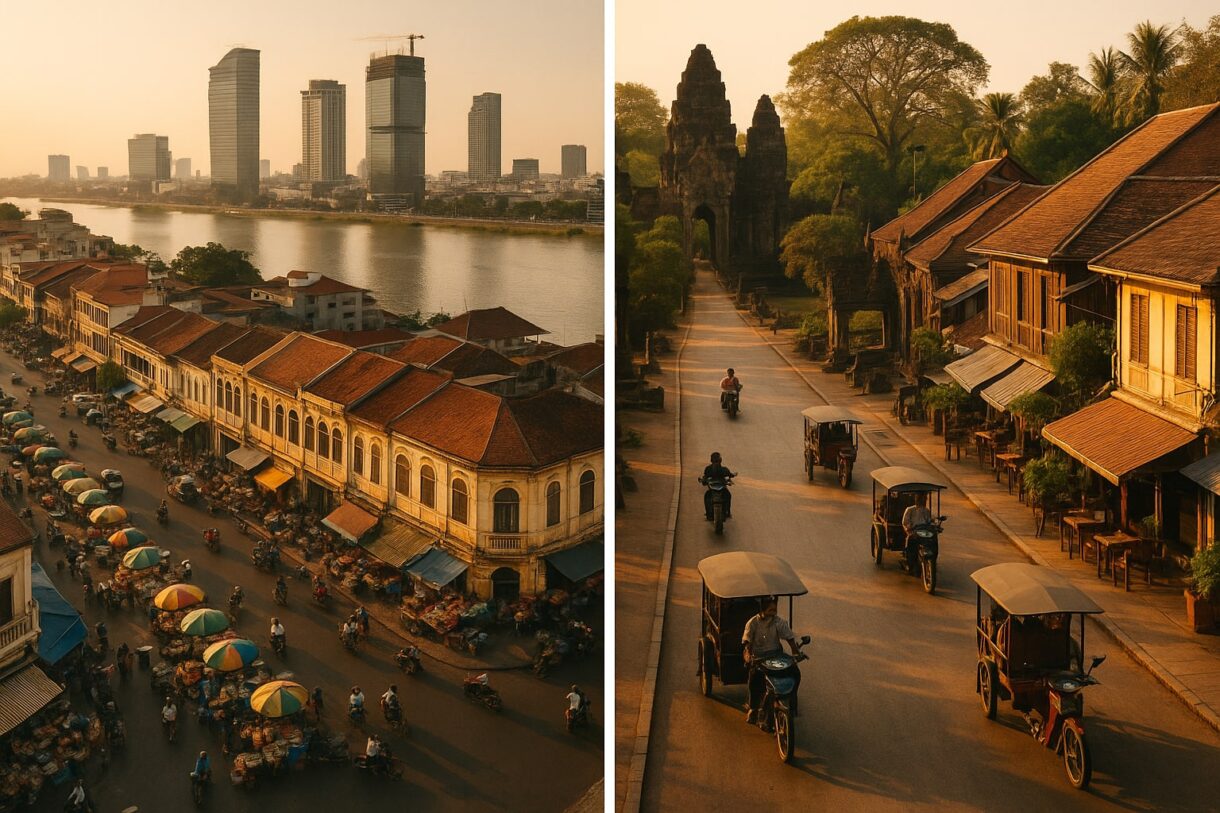
Cambodia is almost always travelled between two points: Phnom Penh, the capital on the banks of the Mekong, and Siem Reap, the gateway city to the temples of Angkor. The first smells of petrol, incense and noodle soup at seven in the morning; the second of wet red earth and the frangipani flowers that surround the temples. They are two very different ways of approaching the country, and understanding what each one offers helps you avoid the standard 48-hour-per-city itinerary that travel agencies sell.
This article is aimed at anyone who wants to travel to Cambodia with good judgement: knowing how much to spend per day, which neighbourhoods to choose, how to get around without falling into the closed circuit of the tourist tuk-tuk, and what to eat beyond the amok served on every menu translated into English.
Why Cambodia is better understood by visiting both cities
Phnom Penh and Siem Reap do not compete; they complement each other. In the capital lies the country’s recent memory — the Khmer Rouge regime between 1975 and 1979, the genocide, the reconstruction — while in Siem Reap the long memory is preserved, that of the Khmer Empire which between the 9th and 15th centuries built Angkor Wat and more than a thousand temples around it. Seeing one without the other leaves the trip lame.
The distance between them is about 315 kilometres along National Highway 6. By bus it takes between 6 and 8 hours; by plane, 45 minutes. Some people make the journey by night train since 2022, although the service is slow and irregular: check timetables on the Royal Railway website before going.
Phnom Penh: the capital that learned to live with its history
The city has around two million inhabitants and is growing fast. The traffic is chaotic — motorbikes, electric tuk-tuks, SUVs with tinted windows — but specific neighbourhoods are pleasant to walk around. The Riverside, next to the confluence of the Mekong and the Tonlé Sap, concentrates the hotels, cafés and an evening breeze that anyone arriving in April at 38 degrees will appreciate.
The Royal Palace and the Silver Pagoda
They are visited together and are open in the morning and afternoon with a midday break. Entry costs around 10 dollars. Shoulders and knees must be covered — at the entrance they rent wraps if you are dressed too short — and you must take off your shoes at the Silver Pagoda, whose floor is tiled with more than 5,000 solid silver tiles, although only a small portion is visible without the protective carpet.
Tuol Sleng and Choeung Ek: the uncomfortable part
The Tuol Sleng Genocide Museum (S-21), a former school turned into a torture centre by the Khmer Rouge, and the extermination camps of Choeung Ek, about 15 kilometres from the centre, are harsh but necessary visits for understanding the country. The Spanish audio guide (included in the entry, around 5–6 dollars at Tuol Sleng and 6–8 at Choeung Ek) is well narrated and avoids sensationalism. It is not a place for young children.
Where to eat without falling into the tourist menu
At the Phsar Kandal market, mid-morning, you can have breakfast on kuy teav (rice noodle soup with pork) for 1.50–2 dollars. To try amok trey — fish steamed with coconut milk, kroeung and banana leaf, perhaps the national dish — avoid the Riverside spots with photos on the menu and look for restaurants such as Malis or Romdeng, the latter run as a cookery school for young people at risk of social exclusion.
Siem Reap: much more than the gateway to Angkor
Siem Reap grew over the last two decades at the pace of tourism. Before the pandemic it received more than two million visitors a year; today the figure has partially recovered and the city retains a manageable scale. Pub Street is the noisiest and most dispensable area; the neighbourhoods of Wat Bo and Kandal Village offer cafés, galleries and guesthouses with more character.
Angkor Wat and the rest of the complex
The one-day pass costs 37 dollars, the three-day pass 62 and the one-week pass 72 (official prices from Angkor Enterprise, unchanged since 2017). It is bought at the official sales centre on the outskirts of the city — not inside the site itself — and a photo is taken on the spot. Sunrise at Angkor Wat is the most crowded moment: if you prefer calm, start with Ta Prohm (the temple devoured by silk-cotton and strangler fig trees) early in the morning and leave Angkor Wat for mid-afternoon, when the tour groups have already left.
Less visited temples
Banteay Srei, about 35 kilometres from the centre, is a small temple of pink sandstone with reliefs of such delicacy that they make up for the journey. Beng Mealea and Koh Ker, further away, require a full day and a car with driver (60–90 dollars, negotiable). This is where the 3- or 7-day passes start to be worth it.
Tonlé Sap Lake and the floating villages
Beware of the standard offer: many tours to Chong Kneas are traps for tourists with forced commercial stops. Kampong Phluk is more authentic and works best between September and January, when the lake is high. Approximate price: 20–25 dollars per person including transport and boat.
How to organise the visit
A reasonable trip to Cambodia requires between 7 and 10 days if both cities are combined. Two or three nights in Phnom Penh are sufficient; in Siem Reap, three or four allow you to see the temples without rushing.
| Concept | Phnom Penh | Siem Reap |
|---|---|---|
| Mid-range accommodation (double room) | 25–60 USD | 20–50 USD |
| Local food per person/day | 10–15 USD | 10–15 USD |
| Urban transport (PassApp tuk-tuk) | 1.5–4 USD per trip | 1.5–4 USD per trip |
| Main entrance | Royal Palace ~10 USD | Angkor 1 day 37 USD |
Best time: from November to February, with temperatures of 24–30 °C and little rain. March and April are sweltering (up to 40 °C). The rainy season (June–October) has the advantage of green landscapes and temples almost empty in the afternoon, although the downpours are intense.
Currency: the US dollar circulates alongside the Cambodian riel. ATMs dispense dollars and tourist prices are marked in that currency; the riel is used for small change.
Visa: e-visa via the official government website (evisa.gov.kh) for roughly 36 dollars, more convenient than the visa on arrival.
If you are combining Cambodia with Vietnam — a very common route — this guide on how to combine Hanoi and Ho Chi Minh City on a realistic budget may be useful, as the logic of prices and transport is similar.
What to bring back
More than souvenirs, the useful memento of Cambodia is a notebook with dish names: nom banh chok (rice noodles with green fish curry, a typical breakfast), lok lak (stir-fried beef with Kampot pepper sauce), num pang (sandwich with French influence). Kampot pepper, with Protected Geographical Indication since 2010, is a purchase that survives the journey and can be found in markets in both cities for 6–10 dollars per small jar.
Frequently asked questions
How much does it cost to enter Angkor Wat in 2026?
The official Angkor Enterprise pass remains at 37 dollars (1 day), 62 (3 days within a 10-day period) and 72 (7 days within a month). It is paid in cash or by card at the official sales centre; it cannot be bought inside the site.
Is it safe to travel to Cambodia?
Yes, in general terms. Violent crimes against tourists are rare; bag snatching from motorbikes in Phnom Penh, however, is not. Carry your bag cross-body and on the side away from the road. Avoid remote rural areas without a guide because of the residual risk of landmines.
How many days do I need to see Phnom Penh and Siem Reap?
With 7 full days you cover the essentials: 2–3 nights in the capital and 3–4 in Siem Reap. Ten days allow you to add Battambang or the coast (Kep, Kampot).
Can you pay in dollars throughout Cambodia?
Yes, the dollar is the practical currency for tourism. Bring banknotes in good condition — they will be refused if torn — and in small denominations (1, 5, 10). Small change for a dollar will be given back in riel.
Is the train between Phnom Penh and Siem Reap worth it?
It is a slow option (10–14 hours) and the service has been intermittent since it reopened. If you want comfort, fly; if you want the experience and have time, the bus from companies such as Giant Ibis is better, with daily departures for 15–20 dollars.
Places of Interest Means of Transport Leisure and Culture #Camboya #ciudades #consejos de viaje #Guía de viaje #templos #transporte público
 Don't get fooled: plan your trip well and avoid these scams on your holidays
 Central Macedonia, the destination Spaniards have discovered to fall in love with Greece
 Summer in Brussels: flowers, festivals and typical gastronomy
Comentarios cerrados