Buenos Aires for Europeans: exchange rates, steakhouses and where to stay
A practical guide to travelling to Buenos Aires from Europe in 2026: how the exchange rate works after the currency unification, which steakhouses deserve a table, and in which neighbourhood to stay depending on what you're looking for.
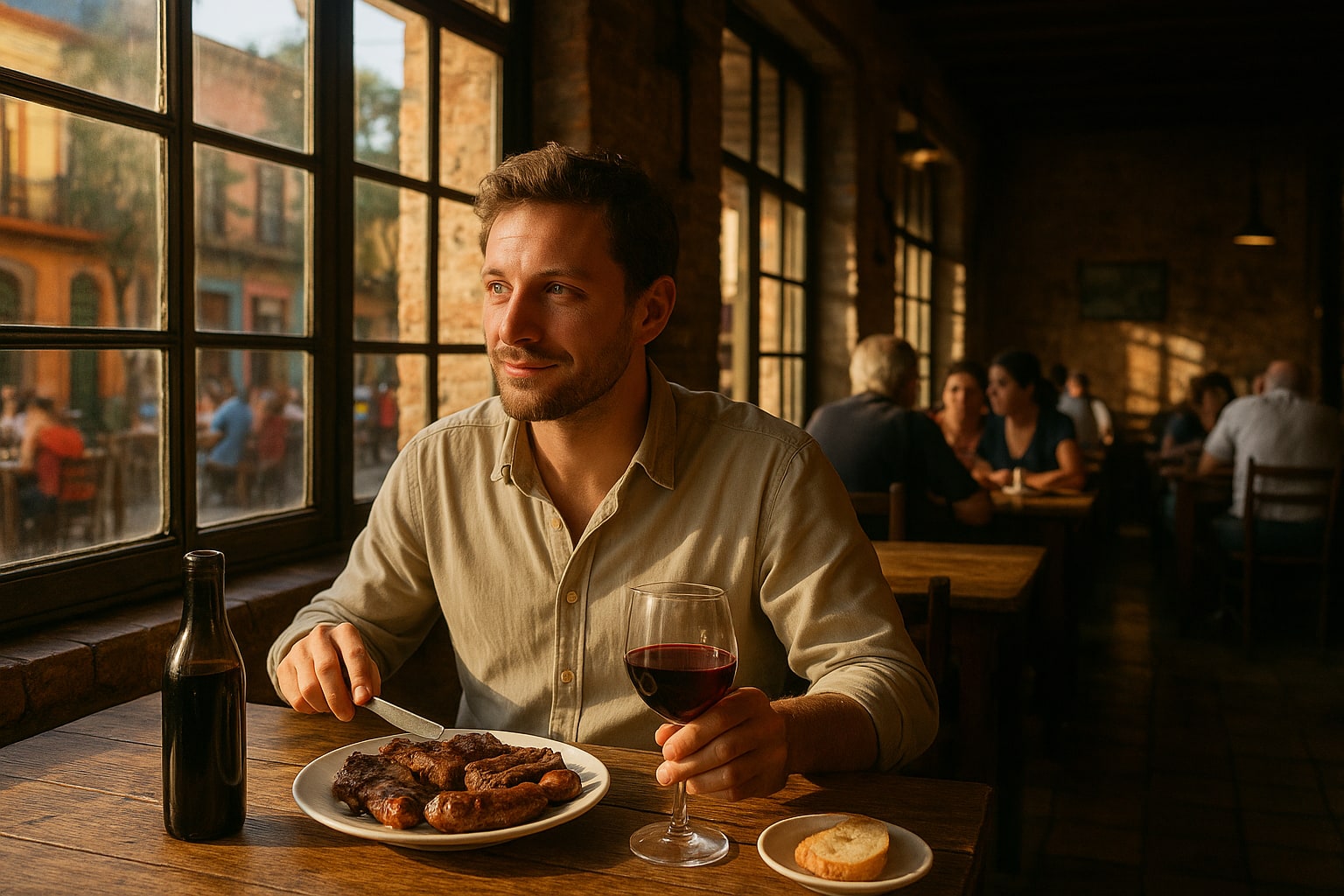
Landing at Ezeiza after thirteen hours of flying from Madrid or Barcelona has a certain productive disorientation to it. The city smells of asado even at ten in the morning, taxi drivers argue about politics as if they’ve known you your whole life, and the prices—those prices you’ve spent months trying to decipher on forums—turn out to be something other than what you read.
Buenos Aires isn’t an obvious destination for the average European. It’s far away, the flight is expensive, and Argentina has spent years in economic instability that confuses almost anyone. But if you’re drawn to cities with layers—neighbourhoods that were once Italian, cafés where Borges wrote, bookshops open until one in the morning—this guide will serve you well.
Why Buenos Aires is worth it (and why now)
The city was built through waves of migration between 1880 and 1930: Italians from Piedmont and Naples, Galicians, Jews from Eastern Europe, Syrians and Lebanese. That mix explains why, on a single block, you can find a pizzeria in the Genoese style, a notable café with 1920s wood panelling, and a parrilla that has been serving bife de chorizo for four generations.
Following the currency unification at the end of 2024, the gap between the official dollar rate and the parallel rate shrank dramatically. That changed the rules for the European tourist: you no longer need to operate through informal channels to get a reasonable exchange rate. Prices, admittedly, have moved closer to European levels in many categories.
How to get there from Europe
Direct flights depart from Madrid (Iberia, Aerolíneas Argentinas, Air Europa), Barcelona (Level, Aerolíneas), Paris (Air France), Rome (ITA), Frankfurt (Lufthansa) and Amsterdam (KLM). Journey time: between 12 and 14 hours depending on the wind. Return fares in 2026 range from 900 to 1,500 € in the low season (May–August, austral winter) and can exceed 1,800 € in December–January.
If you’re flexible, stopovers in São Paulo (LATAM) or Santiago de Chile sometimes lower the fare by 200–300 €. To read fares properly before buying, this guide on how to read the small print of cheap flights will help.
From Ezeiza airport to the centre is about 35 km. The Tienda León bus costs around 15–20 € and takes a good hour. An official taxi or remís costs roughly 30–40 €. Uber and Cabify work, though at Ezeiza they have a designated pick-up area.
Money: exchange, cards and the blue dollar in 2026
Here is one of the most frequently asked questions. After the currency unification, the famous blue dollar lost much of its reason for existing: the gap with the official rate is now small and volatile. It still exists, but it no longer justifies the risk of changing money in backstreet shops for the passing tourist.
The practical side:
- European credit card (Visa/Mastercard): the MEP rate applies, which is the one that matters to the tourist. Pay by card whenever you can.
- Cash in euros or dollars: exchange it at authorised bureaux on San Martín street (microcentro) or at your hotel. Always ask for a receipt.
- ATMs: they charge high commissions and dispense few notes per transaction. Use them only in emergencies.
- Western Union: for years it was the unbeatable option; in 2026 it remains competitive but is no longer clearly advantageous. Compare first.
Carry some cash in pesos for taxis, markets and small cafés. And don’t be surprised if you’re asked to pay in dollars at tourist accommodation: it is legal and common.
The parrillas: what to order and where
The porteño parrilla is not a themed restaurant; it is a neighbourhood institution. The star cut is the bife de chorizo (thick, juicy sirloin), followed by ojo de bife (ribeye) and vacío (flank steak). Among the offal: mollejas (sweetbreads), chinchulines (small intestines) and morcilla (blood sausage). It is accompanied by provoleta (grilled provolone with oregano) and chimichurri.
Some references with a character all their own:
- Don Julio (Palermo, Guatemala 4699): the most internationally known. Book weeks in advance or queue on the pavement with a glass of malbec. It comes to less than 50–70 € per person with wine.
- El Preferido de Palermo (Guatemala 1091): a historic bodegón that has been renovated, mixing parrilla with Spanish immigrant cooking.
- La Cabrera (Palermo, Cabrera 5099): enormous portions and side dishes served in little casseroles. It offers 40% off if you go before 20:00.
- El Desnivel (San Telmo, Defensa 855): a popular parrilla, shared tables, moderate prices. No theatrics.
A reasonable parrilla lunch in a neighbourhood bodegón costs around 20–30 €; in a parrilla with a name, 40–70 €. Argentine beef remains noticeably cheaper than European beef of equivalent quality, though less so than five years ago.
Where to stay: Palermo, Recoleta or San Telmo
The choice of neighbourhood defines the trip. These are the three that work well for European visitors, with caveats.
| Neighbourhood | Profile | Average hotel price (per night) | Pros | Cons |
|---|---|---|---|---|
| Palermo (Soho/Hollywood) | 25–40, nightlife, food | 90–160 € | Restaurants, bars, parks | Noisy, very touristy |
| Recoleta | 40+, culture, calm | 110–200 € | Elegant, museums, traditional café | Less nightlife |
| San Telmo | Quirky, Sunday market, tight budget | 60–110 € | Authentic, tango, architecture | Some areas feel rundown at night |
Palermo is subdivided into Palermo Soho for bars and design, Palermo Hollywood for restaurants, and Palermo Chico, which is more residential. If it’s your first time and you want to walk to dinner, you’ll get it right here.
Recoleta is the Frenchified Buenos Aires: wide avenues, Haussmann-style buildings, the Recoleta Cemetery (where Eva Perón lies; entry around 5–8 €) and the MALBA just a step away. An older crowd.
San Telmo keeps its cobblestones, its conventillos and the San Telmo Market on Sundays along Defensa street. It is the neighbourhood with the most historic texture, but you should move around it with care at night. If you’re travelling on a tight budget, you’ll find hostels and boutique hotels here for 50–80 €.
Avoid Puerto Madero unless you’re after a corporate hotel: it is a new area, without neighbourhood soul, and expensive.
How to organise your visit
With 5–7 days you can see the city without rushing: two days around Palermo–Recoleta (museums, parks, cafés), one in San Telmo including the Sunday market, one in the historic centre (Plaza de Mayo, Café Tortoni, Corrientes avenue), one in La Boca (Caminito by day, never by night) and one to escape to the Tigre Delta by train from Retiro.
Best time: austral spring (October–November) and autumn (March–April). December to February is hot and humid; June–August can be grey and cold, although prices drop.
To get around, the SUBE is the rechargeable public transport card. It is bought at kiosks for around 2–3 € and works on the subte, buses and trains. A journey costs around 0.30–0.50 €. The subte closes around 23:00; after that, taxi or Uber.
What to bring back
An artisanal alfajor de maicena (Havanna is the well-known brand, but try the ones from neighbourhood bakeries), a bag of yerba mate from Misiones and, if there’s room in your suitcase, a bottle of mid-range malbec from Mendoza (Catena Zapata, Achaval-Ferrer, Zuccardi). If you’re interested in literature, stop by El Ateneo Grand Splendid (Avenida Santa Fe 1860), the bookshop in a former theatre, and take home Borges or Saer.
If you’re following a Latin American route, this five-day guide to Mexico City is a good complement: two capitals, two opposite ways of understanding street food.
Frequently asked questions
Is Buenos Aires still cheap for a European in 2026?
Less so than three or four years ago. After the currency unification, high-end restaurants, hotels and transport have moved closer to Madrid or Rome prices. Meat, wine and neighbourhood cafés still cost noticeably less. Budget 80 to 130 € a day per person for mid-range travel.
Is Buenos Aires safe for tourists?
In central tourist areas (Palermo, Recoleta, Puerto Madero, San Telmo by day) the level of safety is comparable to that of major European capitals. Avoid La Boca outside Caminito, Retiro at night, and don’t flash your phone or camera in the street. Official taxis and apps are reliable.
Do I need a visa to travel from Spain or the EU?
No. Citizens of the European Union can enter Argentina as tourists for up to 90 days with a valid passport. No visa or entry fee is required.
What plugs and voltage are used in Argentina?
220 V, but the plugs are type I (two flat pins in a V shape) or the European type C. Bring a universal adaptor just in case, although many hotels accept the European plug directly.
Can you drink tap water?
Yes, tap water in Buenos Aires is drinkable and safe. In bars and restaurants it is customarily served bottled, but you can ask for tap water without any problem.