Kuala Lumpur: daily budget, halal street food and connections to other cities
Practical guide to Kuala Lumpur with real prices in ringgit and dollars, halal dishes with exact addresses, and connections from KLIA to the rest of Southeast Asia.
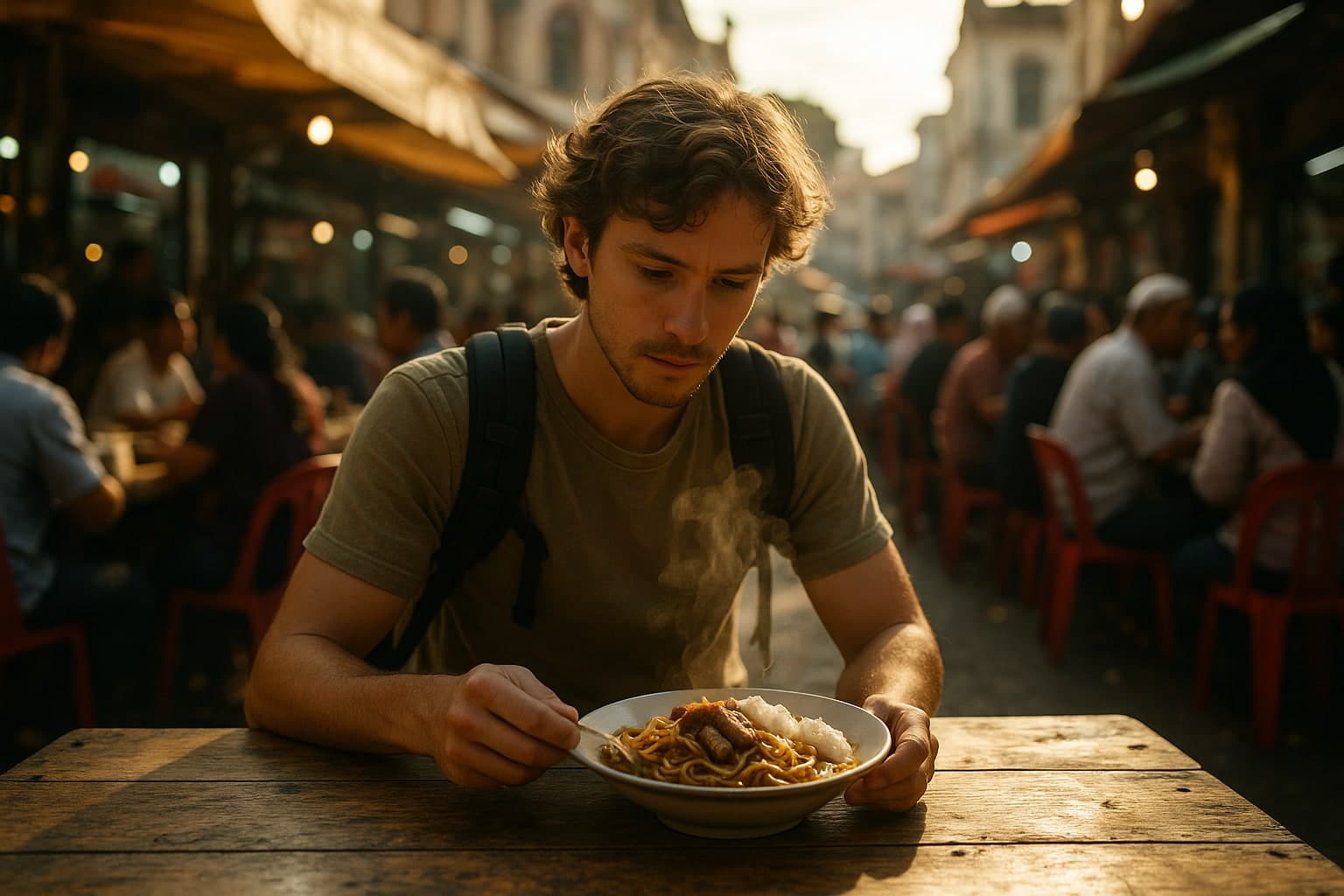
You arrive in Kuala Lumpur and the first thing you notice is the contrast: the Petronas Towers reflecting the sun over a monsoon sky, and two streets away, the smoke from a satay stall grilling over coconut charcoal. The Malaysian capital works this way, like a cultural roundabout where Malays, Chinese and Indians have been cooking, praying and trading for generations in the same square kilometre.
If you travel through Southeast Asia on a medium or tight budget, KL (as everyone calls it) is one of the most convenient hubs in the region. Well-connected airport, public transport that works, cheap and safe street food, and widespread English that saves you many misunderstandings. This guide gets straight to the point: how much you spend per day, what to eat without mistakes, and how to continue on to Penang, Singapore or Bangkok.
Why Kuala Lumpur works as a travel base
Malaysia took its modern form in 1957, and KL consolidated itself as the capital of a federation with three large communities: Malay Muslim, Chinese and Tamil. That mix explains why in a single neighbourhood you can find a mosque, a Hindu temple and a Chinese kopitiam. The city grew on rubber and tin, and since the nineties it has bet on vertical architecture: the Petronas Towers opened in 1998 and still dominate the skyline.
For the traveller, this means an orderly city, with elevated metro lines (LRT and MRT), signage in English and a cost of living well below Bangkok or Singapore. It is not a postcard destination: it is a logistical hub with good food.
Daily budget in Kuala Lumpur: how much you need
Prices are in Malaysian ringgit (MYR). The exchange rate usually moves between 4.5 and 4.8 MYR per dollar, so 1 USD ≈ 4.7 MYR (check before exchanging).
| Profile | Accommodation | Food | Transport | Daily total |
|---|---|---|---|---|
| Backpacker | 40-70 MYR (dormitory) | 25-40 MYR | 10-15 MYR | 75-125 MYR / 16-27 USD |
| Mid-range | 150-250 MYR (3* hotel) | 60-100 MYR | 20-30 MYR | 230-380 MYR / 49-81 USD |
| Comfortable | 400-700 MYR (4-5*) | 150-300 MYR | 50-80 MYR | 600-1,080 MYR / 128-230 USD |
What goes above the average: drinks. A Tiger beer in a bar on Changkat Bukit Bintang costs 20-30 MYR, almost the same as a full dinner at a hawker stall. Malaysia taxes alcohol heavily as a country with a Muslim majority.
Tips for cutting costs
- Eat at kopitiam and hawker markets, not in air-conditioned restaurants.
- Use Grab (the Asian Uber) instead of metered taxis.
- The MyRapid (transport card) can be topped up from 5 MYR and works on the LRT, MRT and monorail.
Halal street food in Kuala Lumpur: what to try and where
Almost all Malay cuisine is halal by default (no pork, no alcohol in the preparation). In Chinese areas you will see stalls with "non-halal" signs: respect the distinction if you share a table with Muslim travellers.
- Nasi lemak: rice cooked in coconut milk with sambal, fried anchovies, peanuts, egg and cucumber. It is the national breakfast. Try it at Village Park Restaurant, in Damansara Uptown, where the queue at 8 in the morning says it all. Around 10-15 MYR with chicken.
- Satay: skewers of chicken or beef with peanut sauce. The benchmark is Sate Kajang Haji Samuri, originally from Kajang, with branches in KL. Ten skewers, about 15 MYR.
- Roti canai: a flaky Indian-Malay flatbread with lentil curry. You find it at any mamak (Indian Muslim eatery) open 24 hours. Costs 2-4 MYR.
- Halal char kway teow: flat noodles stir-fried with prawns and egg. The halal version is found on Jalan Alor, the street food street par excellence, open until after midnight.
- Nasi kandar: a tray of rice with several curries to choose from. Restoran Yusoof dan Zakhir, near Masjid India, is a late-night classic.
Markets and streets to eat
Jalan Alor (Bukit Bintang) is the most touristy but it works: reasonable prices, street tables, atmosphere from 18:00. Kampung Baru, the traditional Malay quarter north of the centre, is the authentic option for nasi lemak and kuih (sweets). On Friday lunchtimes there is a very lively local market.
To have breakfast like a local, look for a kopitiam and order kaya toast (toast with coconut jam and soft-boiled egg) with teh tarik (whipped milk tea). Total: about 8 MYR.
What to see in one or two days
- Petronas Towers and KLCC Park: going up to the skybridge costs about 80 MYR and is booked on the official website. If you are not interested in going up, the park at their base with its fountain at dusk is free and enough.
- Batu Caves: a Hindu temple inside a limestone cave, 13 km from the centre. Take the KTM Komuter train from KL Sentral in 30 minutes for 2-3 MYR. Bring shoulders and knees covered.
- Merdeka Square and Masjid Jamek: the old colonial and Islamic heart. Free.
- Chinatown (Petaling Street): bargaining, counterfeits and good wan tan mee. To look, not necessarily to buy.
- Thean Hou Temple: a Chinese temple on a hill, with city views. Not very touristy.
Air and land connections from Kuala Lumpur
KL has two airports side by side: KLIA (main terminal) and KLIA2 (AirAsia’s base). Both connect to the centre by the KLIA Ekspres (35 minutes, 55 MYR) or by bus (1 hour, 12-15 MYR).
| Destination | Mode | Duration | Approx. price |
|---|---|---|---|
| Singapore | Flight | 1 h | 40-90 USD |
| Singapore | Bus | 5-7 h | 45-90 MYR |
| Penang (Georgetown) | Flight | 1 h | 25-60 USD |
| Penang | ETS train | 4-5 h | 60-80 MYR |
| Bangkok | Flight | 2 h 15 | 50-120 USD |
| Bali (Denpasar) | Flight | 3 h | 80-180 USD |
| Ho Chi Minh | Flight | 2 h | 70-150 USD |
| Melaka | Bus | 2-2.5 h | 15-25 MYR |
| Cameron Highlands | Bus | 4 h | 35-50 MYR |
AirAsia and Batik Air fares vary widely depending on how far ahead you book. Booking two or three weeks in advance often cuts the flight to Bangkok or Bali by half.
How to organise the visit
Two full nights is enough to get to know KL without rushing: one day for Bukit Bintang, KLCC and Chinatown, another for Batu Caves in the morning and Kampung Baru in the afternoon. If you are using the city as a hub, one night is enough between flights.
The best time is May to July, outside the heavy monsoon. From October to March it rains daily, although the showers are usually short. Avoid the eve of Hari Raya (end of Ramadan) if you do not want to find everything closed and transport overcrowded.
What to take home
A bag of ground white coffee from Ipoh (sold in any supermarket for 15-25 MYR) and, if you pass through Chinatown, a jar of tinned sambal. For the next day: board the ETS train bound for Georgetown, Penang, where the street food goes up another notch and the Peranakan architecture alone justifies three more days.
Frequently asked questions
Is it safe to travel to Kuala Lumpur?
Yes, it is one of the calmest capitals in Southeast Asia. The usual problems are pickpockets in Bukit Bintang and scams with taxis that do not use the meter. Use Grab and avoid holding your phone in your hand near motorbikes.
How many days do I need in Kuala Lumpur?
Two full days cover the essentials. If you use it as a base for Batu Caves, Melaka or Genting Highlands, add one or two more.
Can you drink alcohol in Kuala Lumpur?
Yes, in bars, hotels and non-halal restaurants, but it is heavily taxed. A beer can cost the same as a meal. Chinatown and Bukit Bintang have plenty of options.
Do I need a visa to enter Malaysia?
For Spanish passports and those of most Latin American countries, no visa is required for tourist stays of up to 90 days. Confirm on the Imigresen Malaysia website before travelling.
Is it a good base for flying to the rest of Southeast Asia?
Yes. KLIA2 is AirAsia’s hub and cheap flights to Bangkok, Bali, Ho Chi Minh, Manila or Yangon depart from here. It is usually cheaper than flying from Singapore.