Talampaya National Park
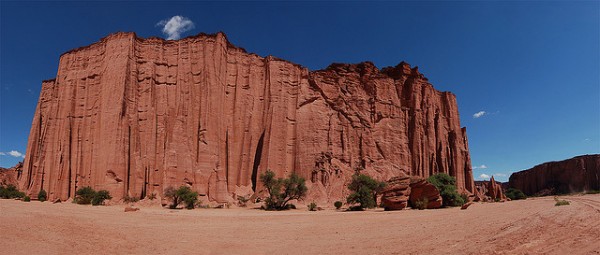
One of the seven World Heritage Sites is Talampaya National Park. It is located in the Province of La Rioja. This site was created in 1975 as a provincial park to protect the archaeological and paleontological sites of the area; only in 1997 did it come under the administration of the National Parks Administration.
The surface area of the park reaches 215 hectares. The site has a beauty that captures the attention of its visitors, as well as its varied fauna and flora. As a result of various tectonic movements, water and wind erosion have occurred, generating a desert-type climate with large temperature ranges. Its mountains reach heights of 1,300 meters above sea level, and the climate falls within the continental type.
The vegetation includes a wide variety of shrubs, among them the achaparrada and the retamo, plants characterized by having no leaves; photosynthesis is carried out through the stems. Some cactus species can also be seen, such as the puquis and several cardones.
As for the fauna, we can tell you that there are 120 species, of which 16 are insects and 104 are vertebrates (such as the grey fox, the mora calandria, etc.). It is common to see birds of prey on the high reddish cliffs (mora eagle, Andean condor, peregrine falcon).
Throughout the year the area experiences extreme temperatures, reaching 50 degrees in summer and dropping to -9 degrees during the months from May to October. The solar radiation in the area is really very strong, and the winds blow all year round. Rains are temporary and usually occur during the summer months; in winter, occasional isolated snowfall may occur.
It is estimated that there was human presence in the region between the years 120 and 1180 of our era, as evidenced by the engravings and paintings seen on stones and ceramics. The area where these cultural legacies can be seen is Los Pizarrones, located near the Talampaya River.
Another important finding is the discovery of remains of dwellings and walls in the area, as well as fragments of fired clay and lithic material resulting from the making of stone tools.
Source | Wikipedia
Photo | Flickr – MG Panoramico
2 comments · Comment
2 comments