Níjar, living pottery and jarapas in the heart of Cabo de Gata
Practical guide to Níjar's pottery and jarapas: where the potters' quarter is, which workshops to visit, how much it costs to buy, and how to combine the visit with Cabo de Gata.
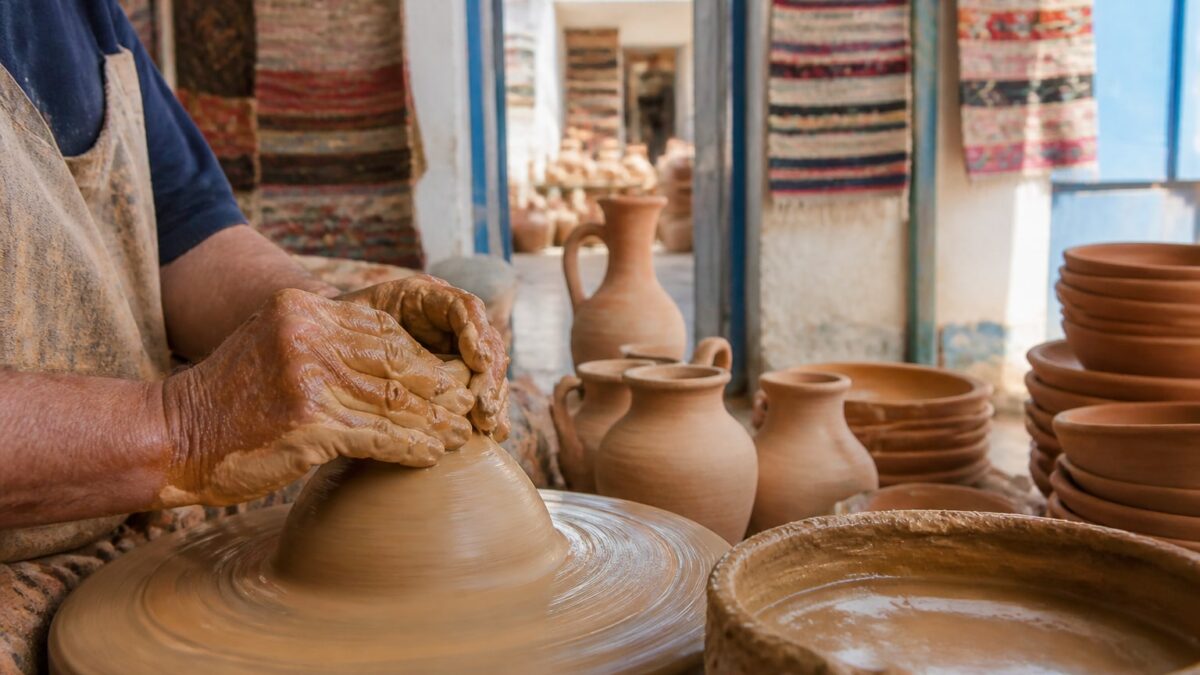
If you have half a day in Cabo de Gata and want something other than the beach, Níjar fits the bill: a village of whitewashed streets about 25–30 minutes’ drive from Almería city, where pottery and jarapas are still made just as they have been for generations, in workshops you can visit without an appointment on most mornings.
This guide is for anyone looking to buy an authentic piece (not a mass-produced replica), to understand what distinguishes a Nijar jarapa from an Alpujarran one, and to plan the visit around the workshops’ actual opening hours rather than a tourist brochure.
Background: between Cabo de Gata and the Arab-Andalusian tradition
Níjar belongs to the municipality that gives its name to the Cabo de Gata-Níjar Natural Park, although the urban centre lies inland, about 7–8 km from the nearest coast. Its name comes from the Arabic Nixar, and the village’s ceramic and textile tradition is rooted in the Andalusian period, when the area formed part of the agricultural alquerías around Almería. The word “jarapa” comes from the Arabic harqa, meaning rag or strip of cloth, and describes the technique quite accurately: strips of fabric interwoven on a loom.
After the expulsion of the Moriscos in the 16th century, the pottery and weaving crafts survived, reinterpreted by the resettling population, and it is this blend—inherited technique, local materials, an aesthetic adapted to the dry landscape of Cabo de Gata—that distinguishes Níjar’s production from other Andalusian pottery centres such as Úbeda or La Rambla.
Níjar’s potters’ quarter: where it is and what you will see
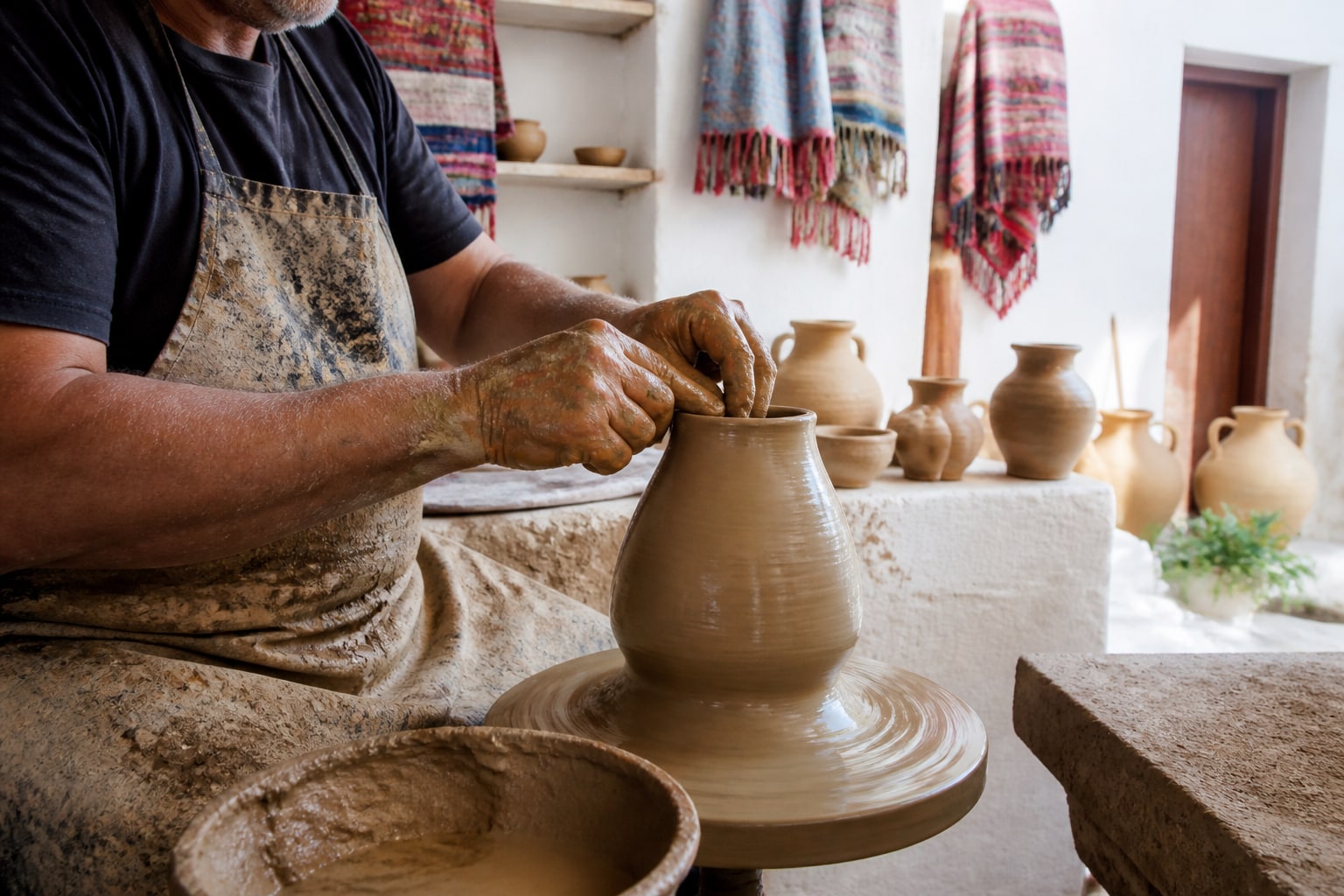
The so-called Barrio de las Eras occupies the eastern edge of the town centre, laid out around Calle Las Eras and Calle Real, the main artery where most workshops open to the public are concentrated. Walking here you see traditional kilns peeking out behind the façades, heaps of clay drying in the sun and, at several doorways, the potter’s wheel still turning in mid-morning.
It is not a museum quarter or a area rebuilt for tourists: people live and work there, and that shows in the rhythm. Some workshops close at midday for lunch and reopen in the afternoon, so it is best not to rush or assume everything will be open at any hour.
Calle Las Eras and Calle Real
On Calle Real most of the shop windows displaying glazed ware are concentrated, while Calle Las Eras—narrower and more residential—is where you see the kilns and working courtyards. A leisurely stroll along both, stopping to look without buying anything, takes about 40–60 minutes.
From Níjar glazed ware to jarapa: two crafts, one pair of hands
Níjar produces two crafts with their own identity, often made by the same families: glazed ceramics and jarapa weaving. They are different trades technically but share something—the reuse of materials and a colour palette that echoes the volcanic and marine landscape of Cabo de Gata.
How a traditional jarapa is made
The Nijar jarapa is woven on a manual wooden loom from strips of reused cloth—formerly old clothes, sheets or scraps—cut into fine bands that form the weft, while cotton thread forms the warp. The result is rugs, blankets and wall hangings with horizontal stripes, thick and durable, originally designed for the cold nights in an area where daytime temperatures can reach 30 °C and night-time temperatures drop considerably.
What visually distinguishes the Níjar jarapa from that of the Granada Alpujarra is colour: here ochre, green and blue tones predominate, recalling the sea and the reddish earth of the Tabernas desert, in contrast to the darker reds and garnets typical of Alpujarran villages such as Pampaneira or Bubión, which you can learn more about in this guide to the Barranco de Poqueira.
Níjar ceramics: motifs and colours
Níjar glazed ware is recognisable by its glaze in green, white and ochre yellow, with hand-painted motifs depicting fish, birds or simple geometric forms. The classic pieces are wall plates for hanging, water jugs, pitchers and cooking pots of low-fired clay, much more porous than industrial ceramics and traditionally designed to keep water cool.
Which workshops to visit and how much it costs to buy
There is no official, up-to-date list of all active workshops—some close on retirement and others reopen with a new generation—so it is wise to confirm opening hours with the municipal tourist office before going if you want to visit a specific one. As a guide to prices (reference data for 2025–2026, subject to change):
| Product | Approximate price range | Where to find it |
|---|---|---|
| Small wall plate (15–20 cm) | 8–15 € | Workshops on Calle Real |
| Medium jug or pitcher | 20–45 € | Workshops on Calle Real and Las Eras |
| Small jarapa (mat, 60×100 cm) | 15–30 € | Textile workshops in the quarter |
| Large jarapa (blanket or wall hanging, 150×200 cm) | 60–120 € | Made to order at several workshops |
| Clay cooking pot | 10–25 € | Utility ceramics workshops |
Prices rise if the piece is entirely hand-painted with complex motifs, and fall for more serially produced ceramics also sold at the weekly market. Haggling is not the custom here: prices are generally already adjusted to the artisanal work.
When to go: season, market and festivals
The best time to visit Níjar without extreme heat is from October to May, avoiding July and August, when temperatures in inland Almería often exceed 35 °C at midday. The weekly market takes place on Sunday mornings in the town centre, and is a good opportunity to see handicrafts alongside local food stalls.
For patron saint festivals and specific events, check the updated calendar on the Níjar Town Council website, as dates can vary from year to year.
Getting to Níjar and getting around
From Almería city, Níjar is about 25–30 minutes’ drive via the A-7 and AL-3115, the most practical option since public transport in the area is limited. Inter-urban buses run by Almería transport consortia connect both points several times a day, with a slightly longer journey of around 40–50 minutes.
Once in the village, the entire potters’ quarter is covered on foot: the old town is small and you do not need a vehicle to move between workshops. If you are coming from the Cabo de Gata coast (San José, Las Negras or Agua Amarga), allow 20 to 35 minutes by car depending on your starting point.
What to see and do nearby: Cabo de Gata in a day
Combining Níjar with the park’s coastline is the most common way to plan the visit. Nearby points of interest:
- Rodalquilar, a former gold-mining village converted into a settlement with rural accommodation, about 20 minutes away.
- San José, the park’s main tourist village, with beaches such as Los Genoveses accessible on foot or by car.
- Las Negras and Agua Amarga, quieter fishing villages with less tourist infrastructure.
If your trip includes other areas of Andalusian white villages with their own artisanal or gastronomic identity, Vejer de la Frontera, in Cádiz, offers an interesting contrast with its tradition of bluefin tuna and Andalusian pastry-making.
Common traveller mistakes
The most frequent is going in August at midday expecting the workshops to be open: many close from 2 pm to 5 pm because of the heat. Another mistake is confusing the industrial ceramics sold in souvenir shops in the centre with the handmade ware from the potters’ quarter; the price and finish give the difference away, but it is worth asking directly whether the piece was made in the workshop where you buy it. It is also common to underestimate the time needed: with 2–3 hours you do not have enough to explore the quarter calmly and continue to the coast the same day without rushing.
Who this visit suits
| Traveller profile | Is Níjar a good fit? |
|---|---|
| Interested in crafts and local culture | Yes, it is the main reason for the visit |
| Family with young children | Yes, a short visit with no steep slopes, though not especially designed to entertain them |
| Traveller looking for beach and nature | As a complementary stop on a Cabo de Gata route |
| Anyone looking for nightlife or a wide hotel offer | No, Níjar is a small village without that kind of offer |
FAQ
How much does an authentic Níjar jarapa cost? Small pieces, such as mats, usually run about 15–30 €, while a large blanket or wall hanging made to measure can exceed 100 €. The price depends on size, complexity of the weave, and whether it is a unique piece or a more serially produced item.
Can you visit a pottery workshop without booking? Yes, most workshops on Calle Real and Calle Las Eras are open to the public during morning hours without an appointment, although it is worth confirming by phone if you want to see the full wheel-and-kiln process.
How much time do you need to see the potters’ quarter? 1.5–2 hours is enough to walk through the main workshops and shop at a relaxed pace, not counting travel from the coast or from Almería city.
Is the Níjar jarapa the same as the Alpujarra one? No. They share the strip-cloth loom technique, but the colour palette differs: Níjar uses ochre, green and blue tones inspired by the Cabo de Gata landscape, while the Alpujarra tends toward darker reds and garnets.
Is there a market in Níjar? Yes, it takes place on Sunday mornings in the town centre, with handicrafts and local products.
What else can I see near Níjar on the same trip? The Cabo de Gata-Níjar Natural Park, with settlements such as San José, Las Negras, Agua Amarga and the former mining village of Rodalquilar, all within 20–35 minutes’ drive.
Practical wrap-up
If you only have one morning, spend two hours strolling Calle Real and Calle Las Eras at an unhurried pace, go into at least two different workshops to compare prices and techniques, and keep the afternoon free to head down to the Cabo de Gata coast before the light fades, which on this stretch of the Almería coastline is usually the best part of the day.



0 comments · Comment