The Giant Buddha of Leshan
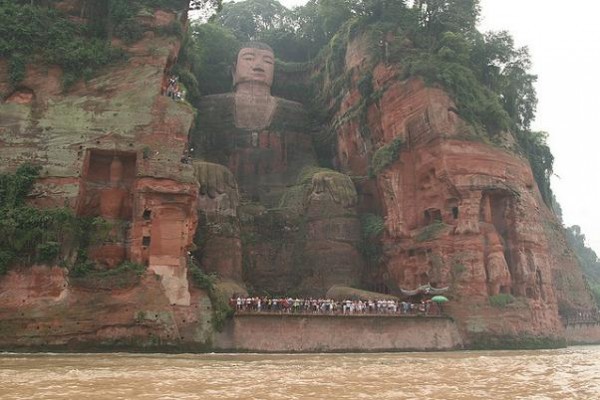
Mount Emei is one of the most important sacred sites in Buddhism. Here, the first Buddhist temple in the country was built in the 1st century, and several more followed later. In the 8th century, a Buddha figure that is the largest in the world was carved into a hillside.
Both the panoramic landscape of Mount Emei and the Giant Buddha of Leshan have been World Heritage Sites since 1996. They are located a few hours by bus from Chengdu, in Leshan, in Sichuan Province. The statue is 71 meters tall and depicts a Maitreya Buddha, seated with its hands resting on its knees. The width of its shoulders is 28 meters.
The idea of carving such a giant came from the Chinese monk Haitong. He hoped that this would calm the waters of the three rivers that converge there, the Minjiang, Dadu and Qingyi, which were causing the destruction of numerous boats. And so it was. When it was completed 90 years later, in 803, the waters calmed considerably. But there is nothing miraculous about it. The debris that was removed from the mountain was deposited in the water, altering the currents and logically slowing them down.
To prevent erosion, the Giant Buddha has several drainage channels in its hair, the back of its ears, its neck and its chest. In addition, they have never stopped maintaining it in good condition, and thanks to this it has stood for more than 1,200 years. It can be visited by ferry or by car, and you can climb up to a terrace at the height of the ear. There you can also see an exhibition about the construction of Dafo, as this Buddha is known.
The ferry is taken from Leshan, and the excursion lasts a total of 40 minutes. The boat stops below the Buddha so that those who wish can get off and take photos. The ferry allows you to see two guardians carved into the cliff that cannot be seen from any other place, in addition to the walled pink monastery from the year 742. You can also get there by bus or taxi, which allows you to enter the park and go up and down the monument. It is advisable to avoid the mornings due to the large influx of Chinese tourists. The queues to climb up to Buddha’s ear can last up to two hours.
In winter there is a third option: an island forms right opposite the Buddha, which can be reached by ferry. You won’t be able to reach the statue, but you will have a good view.
Source | Sacred Destinations
Photo | Flickr-Bernt Rostad