Dubai on a budget: what a trip really costs and how to avoid tourist traps
What a trip to Dubai really costs in 2024, with figures in US dollars and Mexican pesos, and the tourist traps worth avoiding before you land.
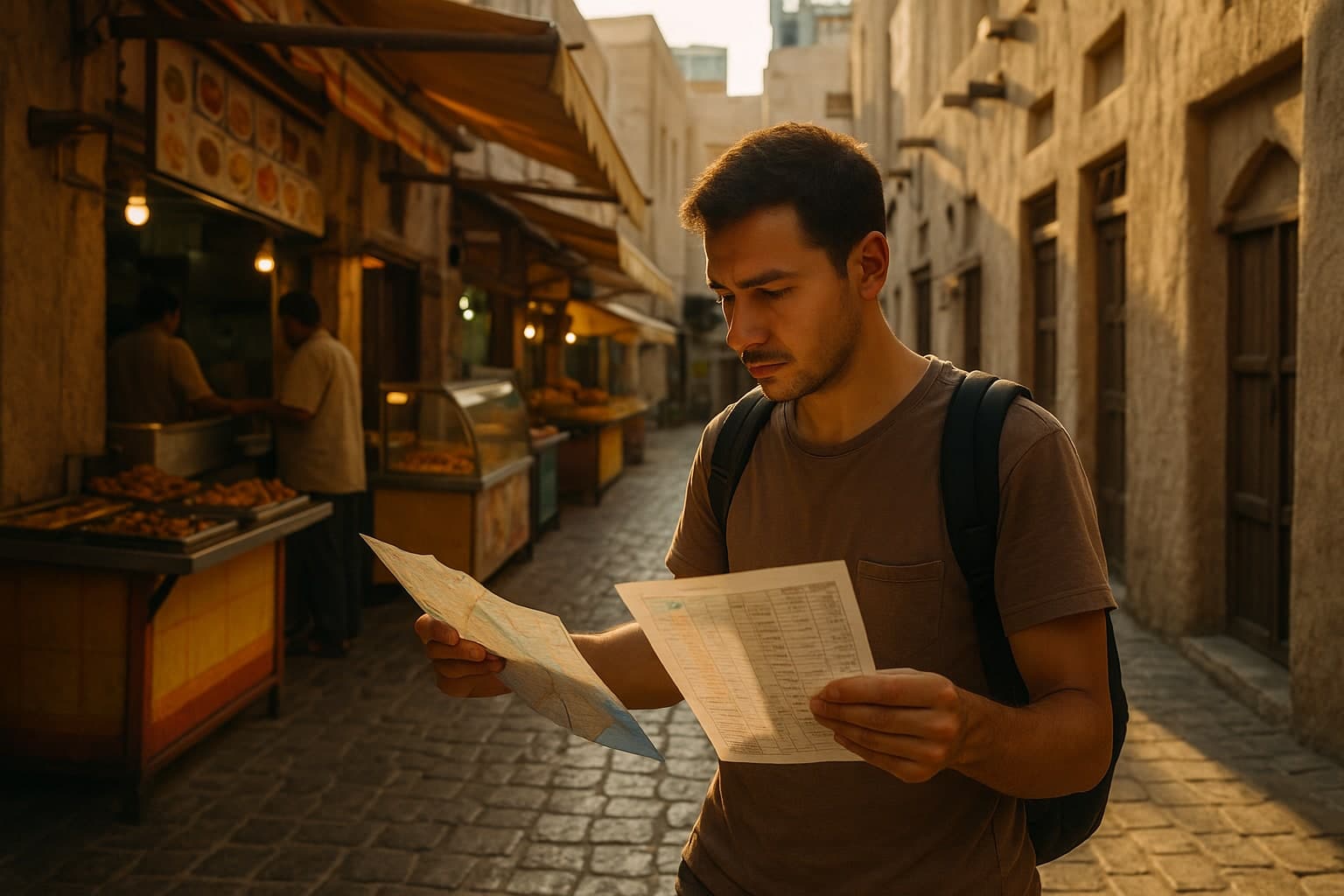
You arrive in Dubai expecting impossible skyscrapers and end up eating biryani for less than five dollars in Al Karama, while an elevated train passes over your head every four minutes. The city has two faces: the one that appears on Instagram —200-dollar brunches at the Burj Al Arab, VIP safaris with a private falconer— and the other one, in the neighborhoods where 85% of its expatriate population lives: Indian, Pakistani, Filipino, Egyptian. That second Dubai is what makes the trip possible without mortgaging your year-end bonus.
This article is written for anyone who wants to go to the Emirates without playing the game of performative luxury. You will read concrete figures, where the money really goes, and where the traps are that charge the newcomer dearly. If you are looking for an all-inclusive resort, this is not your text.
Why Dubai was sold as an expensive destination (and why it isn’t entirely)
Dubai built its tourism brand in the 2000s around luxury: the Burj Al Arab opened in 1999, the Palm Jumeirah was delivered in 2006, the Burj Khalifa in 2010. The official narrative always aimed at the high-spending traveler. But in its day-to-day, the city runs on an economy of cheap services: the metro costs less than in Madrid, the taxi less than in Mexico City, and eating at a Pakistani canteen in Deira costs around 4-6 dollars.
The trap is not in the official prices. It lies in the circuits designed for tourists: marinas, malls, desert. That is where the average ticket multiplies by ten.
How much a trip to Dubai costs: real figures for 2024
These are indicative ranges for one person, one week, without luxury but without sleeping in a hostel. Approximate exchange rate: 1 USD ≈ 17 MXN, 1 USD ≈ 1,000 ARS (check before traveling, it varies a lot).
| Item | USD range/week | MXN equivalent |
|---|---|---|
| Round-trip flight from CDMX/MEX | 1,100 – 1,600 | 18,700 – 27,200 |
| Flight from Madrid | 450 – 750 | — |
| 3* accommodation in Deira or Bur Dubai | 350 – 550 | 5,950 – 9,350 |
| Food (local mix + some restaurants) | 120 – 200 | 2,040 – 3,400 |
| Transport (metro + some taxis) | 35 – 60 | 595 – 1,020 |
| Entrance fees and excursions | 150 – 280 | 2,550 – 4,760 |
| Total week without flight from LatAm | 655 – 1,090 | 11,135 – 18,530 |
Adding a flight from Mexico, a seven-night trip costs between 1,750 and 2,700 dollars per person. From Spain, between 1,100 and 1,850 euros. It is expensive, yes, but comparable to a week in New York or Tokyo.
Flights: when to buy and where it’s cheapest to depart from
Fares drop between May and September, when the heat in Dubai goes above 40 °C and tourism plummets. If you can tolerate the oven (with air conditioning everywhere, it is more bearable than it sounds), you save 30-40% on flights and hotels.
From Latin America, Emirates operates a direct flight from São Paulo and Buenos Aires. From Mexico there is usually a stopover in Europe or the United States. From Spain, Emirates and Iberia operate direct Madrid-Dubai flights in about 7 hours.
Accommodation: where to sleep without paying for the marina
Forget Downtown and Dubai Marina if you want real economy. The neighborhoods with the best value for money are:
- Deira: old Dubai, next to the Creek. 3* hotels from 50-70 USD per night. Ten minutes from the Gold Souk and the Spice Souk.
- Bur Dubai: across the Creek from Deira. A mix of small hotels and apartments. Close to the Dubai Museum and the historic Al Fahidi neighborhood.
- Al Karama: residential, with the city’s best Indian and Filipino restaurants. Short-term rental apartments from 60 USD.
Avoid booking “5* hotels at 3* prices” in areas like Al Barsha with no metro nearby: the savings go into taxis.
Transport: the metro changes everything
The Dubai Metro has two lines (Red and Green) that cover practically everything a tourist wants to see. A single ticket costs between 3 and 8 AED (0.80 – 2.20 USD) depending on zones. The Nol Card, bought at any station for 25 AED with credit included, is the sensible option.
Official taxis (RTA, cream-colored with multicolored roofs) are cheap: an average ride costs between 20 and 40 AED. Careem and Uber work, but are usually 20-30% more expensive than the official taxi.
Eating well for 5 dollars (and where not to fall)
The South Asian canteens in Al Karama, Satwa and Deira serve thalis, biryanis and curries for 15-25 AED (4-7 USD). Ravi Restaurant in Satwa, open since 1978, is a Pakistani institution where taxi drivers and bankers have dinner alike.
By contrast, hotel brunches —a tradition imported by British expats— cost between 250 and 800 AED per person. It is a social experience, not a gastronomic one. You decide whether it fits your budget.
Try the karak chai (spiced milk tea) at any neighborhood café: 1-2 AED for a small cup.
Tourist traps to avoid
- 30-dollar desert safari: if they offer it that cheap, they will take you to a crowded camp with a chain-restaurant dinner. Decent safaris with operators such as Platinum Heritage or Arabian Adventures run around 100-180 USD.
- “Free” tours to the Burj Khalifa: they take you to a viewpoint in a nearby hotel and charge you a 150 AED minimum spend. The official Burj Khalifa entrance costs between 169 and 379 AED depending on the time; buy it on the official website days in advance.
- Unofficial taxis at the airport: ignore anyone who approaches offering “taxi, taxi”. Go to the official cream-colored taxi queue.
- Currency exchange at the airport: you lose up to 8%. Exchange at Al Ansari or UAE Exchange offices in the city.
- Shopping at the Gold Souk without bargaining: the opening price is 30 to 50% higher than the closing price. It is part of the game, not an offense.
What to do spending (almost) nothing
- Walk through the Al Fahidi Historical District: coral houses with wind towers, galleries and the Coffee Museum. Free entry to most courtyards.
- Cross the Creek on an abra (traditional boat): 1 AED per crossing.
- Jumeirah Public Beach or Kite Beach: public beaches with a view of the Burj Al Arab, at no cost.
- Alserkal Avenue, in Al Quoz: a district of contemporary art galleries in former warehouses. Free entry.
- Visit the Jumeirah Mosque with the guided tour of the Sheikh Mohammed Centre for Cultural Understanding (around 35 AED, includes tea and dates).
How to organize the visit
Five to seven nights are enough. The best time runs from November to March, with temperatures of 20-28 °C; it is also high season, with prices 40% above summer. December and January are the most expensive months because of the Dubai Shopping Festival and European tourism.
You need a passport with six months’ validity. Mexicans, Argentinians and Spaniards enter without a prior visa (90 days for the first, free stay for the second as tourists). Confirm requirements on the website of the UAE ICP before the trip, as the rules change.
Dress with common sense: shoulders and knees covered in public areas and mandatory in mosques. On beaches and hotel pools, a normal swimsuit is fine.
What to take back from there
A bag of Medjool dates from Bateel or any Lulu supermarket (much cheaper), and a pack of karak chai sachets to recreate the ritual at home. If you have an extra day, consider a trip to Sharjah, the neighboring emirate, with a restored old quarter and museums for a fraction of Dubai’s prices: the regional train doesn’t connect yet, but the E306 bus from Union Square leaves for 10 AED.
Frequently asked questions
How much does a one-week trip to Dubai cost from Mexico? Between 1,750 and 2,700 USD per person all-inclusive (flight, 3* hotel, meals and moderate excursions). By going down to hostels and eating only at local places, it can be adjusted to 1,400 USD.
Is Dubai safe for tourists? Yes, it is one of the cities with the lowest rate of common crime in the world. The precautions are more legal than security-related: don’t photograph people without permission, don’t show affection in public, and don’t drink alcohol outside authorized hotels.
Can you travel to Dubai with children? Yes, the city is designed for families: water parks, KidZania, the Dubai Mall aquarium. Hotels usually accept two children under 12 at no extra charge in the parents’ room.
What is the best time to go cheaply? June, July and August. Extreme heat (40-45 °C), but hotel prices up to 50% lower and flights 30% cheaper. Everything is air-conditioned.
How much does it cost to go up the Burj Khalifa? Between 169 AED (46 USD) for level 124-125 outside peak hours, and 379 AED (103 USD) for SKY during sunset hours. Book on the official website two or three days in advance.