Money in Tokyo: cash or card, working ATMs and how much to carry
How much cash to bring to Tokyo, which ATMs accept foreign cards, and when to pay with Visa, IC card or mobile Suica. Practical guide with figures in yen and pesos.
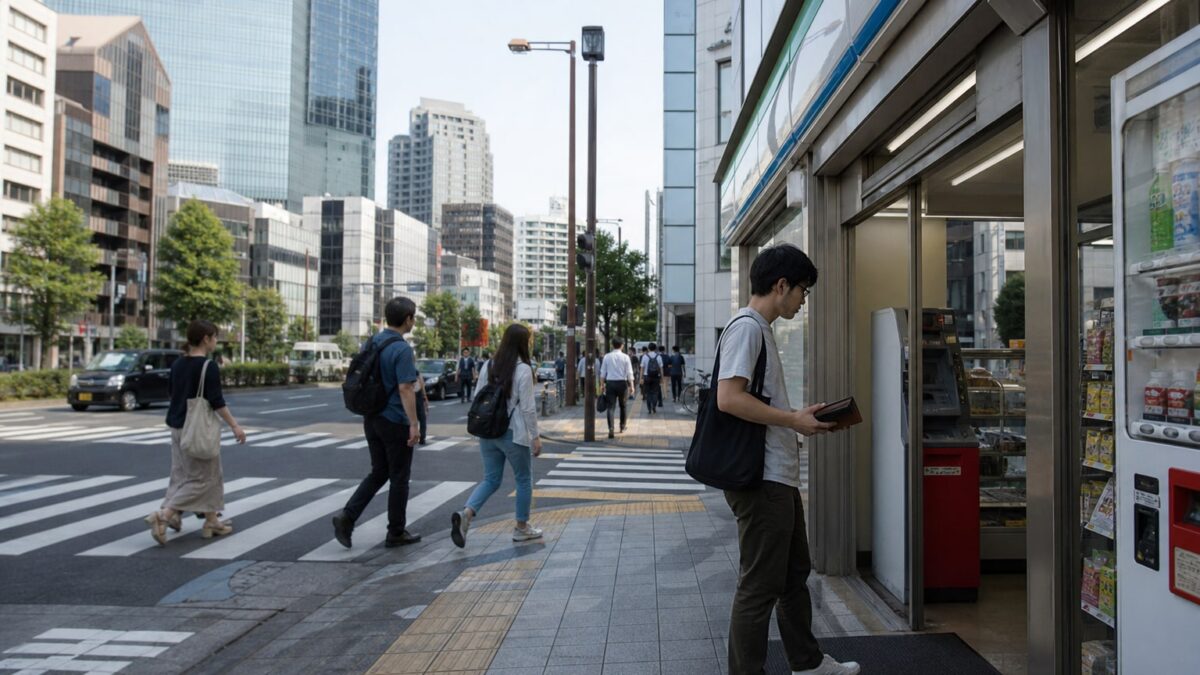
The short answer: in Tokyo you need both things. Japan is still a country where between 40% and 60% of daily transactions are made in cash, but Visa and Mastercard cards work without any problem in hotels, large chains, konbinis and most mid-to-upper-range restaurants. An average traveler gets by well with 10,000 to 15,000 yen per day in cash (about 1,200 to 1,800 MXN, or 60-90 €) and the card as a backup for large payments.
This guide is useful if you are traveling to Japan for the first time, if you are coming from Mexico or Spain and don’t know whether to exchange yen before leaving, or if you worry about running out of money on a Sunday night in Shimokitazawa. Let’s get to the point: ATMs that work, how much to withdraw at once, which card to use and when cash still rules.
Why Japan is still a cash country
Tokyo looks futuristic, but its payment system is not quite so much. For decades, the combination of low crime, a culture of saving and a conservative banking infrastructure kept cash king. The Japanese government began pushing “cashless” from 2019 (with the Olympic Games as a catalyst) and the pandemic accelerated the change, but many small businesses—neighborhood izakayas, temples, ramen shops with ticket machines, markets—still operate only with bills and coins.
If you arrive thinking you’ll pay for everything with your phone like in Stockholm or Copenhagen, you’ll be frustrated. Here is the practical reality.
Quick reference: money in Tokyo
| Item | Value |
|---|---|
| Currency | Japanese yen (JPY, ¥) |
| Approx. exchange rate (Nov 2026) | 1 € ≈ 160 ¥ / 1 MXN ≈ 8 ¥ |
| Recommended daily cash | 10,000-15,000 ¥ |
| Reliable ATMs for foreign cards | 7-Eleven, Japan Post, Lawson, FamilyMart |
| Typical withdrawal fee | 110-220 ¥ + your bank’s fee |
| Card payment accepted | Hotels, large chains, konbinis, mid-range restaurants |
| Cash only | Temples, small izakayas, markets, rural taxis |
Cash or card: when to use each
The practical rule is simple. Card for lodging, for big purchases (electronics at Yodobashi or Bic Camera), for hotel restaurants and for any establishment with a visible Visa/Mastercard logo. Cash for everything else: street food stalls in Ameyoko, temples like Senso-ji (donation of 100-500 ¥), garden entrance fees, short taxi rides, izakayas in Golden Gai (where they often also charge an otōshi or cover charge of 300-700 ¥), and any place with a ticket machine at the entrance.
American Express and Diners Club have more limited coverage than Visa and Mastercard. If you only carry Amex, be prepared to withdraw cash more often.
ATMs that accept foreign cards
Not all Japanese ATMs read foreign cards. Those from local banks such as MUFG, SMBC or Mizuho often reject international Visa, especially outside office hours. The ones that always work with foreign cards:
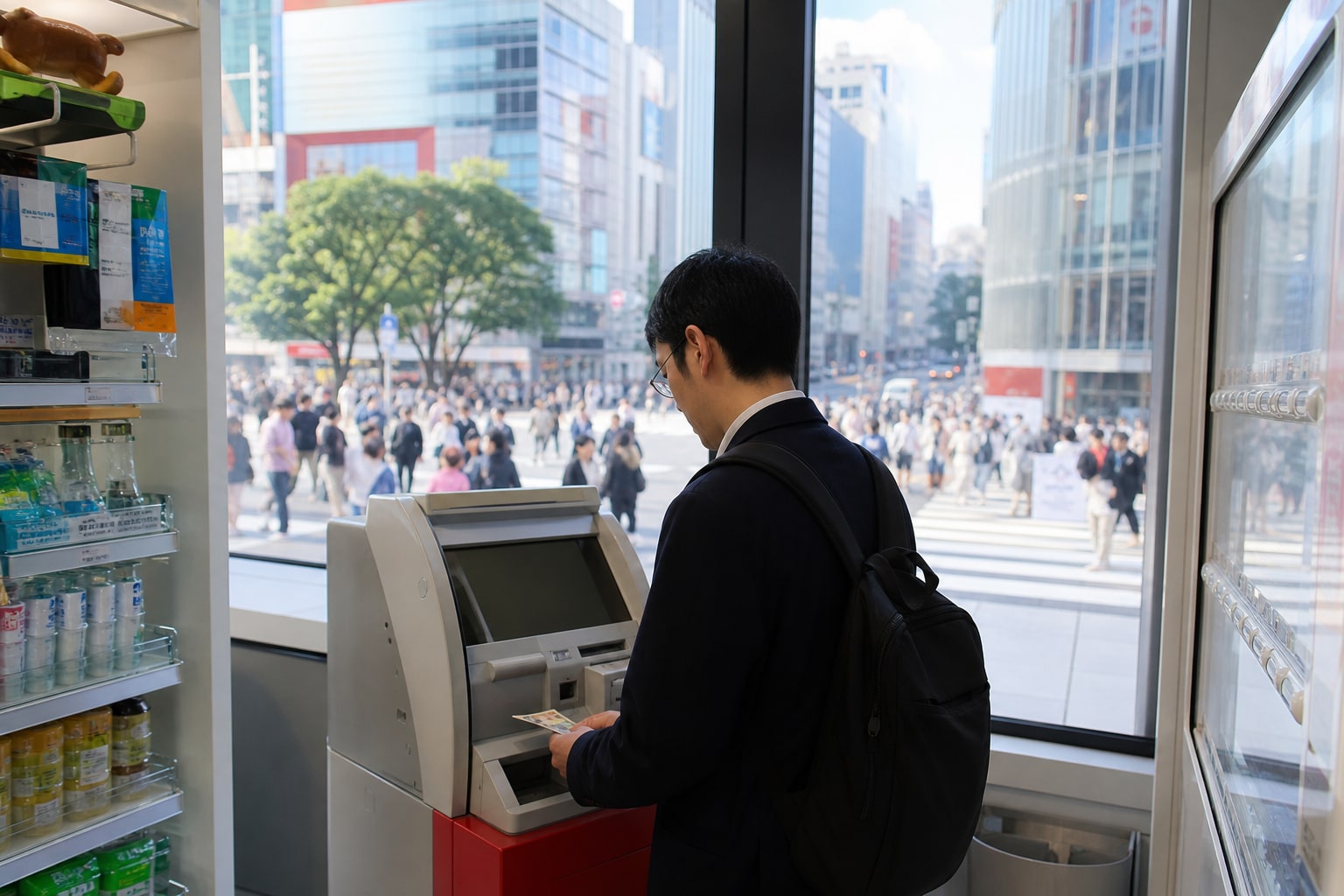
- Seven Bank (inside 7-Eleven): the easiest option. There is a 7-Eleven every few streets, they operate 24/7, and the menu is available in Spanish, English and Portuguese. They accept Visa, Mastercard, Maestro, Cirrus, American Express, UnionPay and JCB.
- Japan Post Bank (Yucho): at post offices. More limited hours (they usually close around 20:00-21:00 and at midday on Sundays), but low fees.
- Lawson Bank: at Lawson konbinis. Multi-language interface, 24 hours.
- FamilyMart (E-net): also reliable, although some older machines may fail with certain European cards.
Avoid generic ATMs in metro corridors or at regional banks if you want no surprises. If your card gets blocked, it’s probably not the ATM: it’s your bank. Notify them before traveling.
Fees and how much to withdraw at once
Seven Bank charges 110 ¥ per withdrawal until 21:00 and 220 ¥ outside that time, although fees vary depending on the amount. Add what your home bank charges per foreign transaction: between 1% and 4% depending on the issuer.
To minimize fees, withdraw large amounts at once. The usual maximum per transaction at Seven Bank is 100,000 ¥ (about 625 € or 12,500 MXN), although your bank may limit it further. Withdrawing 30,000-50,000 ¥ every three or four days is a good balance between having enough cash and not carrying too much.
Cards like Revolut, Wise, N26 or the Mexican ones with no foreign withdrawal fee (some from Nu, Hey Banco) save you the home bank’s share. You still pay the 110-220 ¥ Japanese ATM fee.
Exchanging euros or pesos into yen: where is it best?
Exchange rates in Tokyo are usually better than at the airport in your departure country, but not much better than withdrawing directly from an ATM. If you want to exchange cash:
- Travelex and offices at Narita or Haneda: convenient right after arrival, acceptable exchange rate. If you arrive without a single yen, exchange 10,000-20,000 ¥ for the first few days.
- World Currency Shop and offices in Shinjuku, Shibuya or Ginza: slightly better rates than the airport.
- Hotels: poor rates, only for emergencies.
Exchanging Mexican pesos directly into yen in Japan is complicated and not very profitable: many shops don’t accept them or apply penalized rates. If you’re coming from Mexico, it’s better to bring dollars or euros, or simply withdraw with your card at Seven Bank. To get oriented on arrival and first expenses, this guide on how to get from Narita or Haneda airport to the city center may help.
IC cards: Suica and Pasmo, much more than transport
IC cards (Suica, Pasmo, Icoca and similar) are rechargeable contactless cards. You use them on the metro, JR trains, buses and also to pay at konbinis, vending machines, many restaurants and luggage lockers. The maximum balance is 20,000 ¥.
Since 2023 there has been intermittent shortage of physical cards, but if you have an iPhone you can add a virtual Suica or Pasmo in Apple Wallet and top it up with a credit card from the app. On Android with Google Pay it only works if the phone has Felica (models originally sold in Japan or some recent global ones).
For a one-week trip, loading 3,000-5,000 ¥ at the start and topping up on the go is enough. Each metro ride costs between 170 and 320 ¥.
Mobile wallets: PayPay, LINE Pay and the rest
PayPay is the dominant wallet in Japan (over 60% of the market). The problem for the traveler: it requires a Japanese phone number and a local bank account to register fully. There are limited versions that accept foreign cards, but it isn’t worth fighting with the app for a short trip.
Apple Pay and Google Pay with your usual cards work at contactless terminals, which are found in almost every chain (konbinis, Uniqlo, Starbucks, stations). It’s the cleanest method: you don’t need to register for anything locally.
Realistic daily budget in Tokyo
Approximate figures for November 2026, per person and per day, already at the destination (excluding flight and accommodation):
| Profile | Food | Transport | Entrance fees/leisure | Daily total |
|---|---|---|---|---|
| Backpacker | 2,500-3,500 ¥ | 800-1,200 ¥ | 500-1,500 ¥ | 4,000-6,000 ¥ |
| Mid-range | 5,000-8,000 ¥ | 1,000-1,500 ¥ | 1,500-3,000 ¥ | 8,000-13,000 ¥ |
| Comfortable | 10,000-18,000 ¥ | 1,500-2,500 ¥ | 3,000-6,000 ¥ | 15,000-25,000 ¥ |
Add accommodation on top: from 3,000 ¥ in a shared hostel up to 25,000 ¥ or more in hotels in neighborhoods like Ginza. If you’re deciding on an area, check this comparison of neighborhoods to stay in Tokyo.
A coffee at Doutor costs 250-350 ¥. A decent ramen, 900-1,400 ¥. A dinner at an izakaya with a couple of beers, 3,500-5,500 ¥. Entrance to Rikugien garden, 300 ¥. A short 2 km taxi ride, about 1,000 ¥.
Common money mistakes in Tokyo
- Relying only on the card: you’ll get stuck at some izakaya or temple.
- Not notifying the bank before traveling: many block the card at the first Japanese withdrawal.
- Withdrawing little and often: you multiply fees.
- Exchanging euros at the hotel: terrible rates.
- Tipping: tipping isn’t done in Japan. It can offend. The same goes for leaving coins on the table.
- Paying with a 10,000 ¥ bill at a small stall: they don’t always have change. Carry 1,000 ¥ bills and 500 ¥ coins.
Cash safety
Tokyo is one of the safest large cities in the world. Carrying 30,000 or 50,000 ¥ on you is not a real risk as it would be in other capitals. Even so, use common sense: avoid withdrawing large amounts in front of the machine, keep the receipt (the ATM usually asks if you want it) and split your cash between your wallet and your hotel.
The classic scams are concentrated in Kabukicho (Shinjuku) and Roppongi, where touts invite people to bars with inflated bills. Never follow someone who approaches you on the street to take you to a venue.
Frequently asked questions
Can I pay for everything with a card in Tokyo? No. You can pay at most hotels, konbinis and mid-range restaurants, but you need cash for temples, many izakayas, street stalls, some taxis and small entrance fees. Plan on at least 5,000-8,000 ¥ per day in cash.
How much money should I bring to Tokyo for a week? For a mid-range profile, about 70,000-90,000 ¥ (about 440-560 € or 8,700-11,200 MXN) covers food, transport and leisure for seven days. Accommodation is separate. The convenient approach is to bring 10,000-20,000 ¥ in cash from home or from the airport and withdraw the rest at Seven Bank.
Do Revolut and Wise cards work in Japan? Yes, without problems at Seven Bank, Japan Post and Lawson ATMs. You save the traditional bank’s exchange fee, although you still pay the 110-220 ¥ Japanese ATM fee.
What if my card doesn’t work at the ATM? First try a Seven Bank (the most compatible). If that doesn’t work either, the problem is almost certainly your bank: call them. Always carry a second card from another bank as a backup.
Is it worth buying a physical or virtual Suica? Virtual if you have an iPhone, definitely: you top it up from the sofa and use it for the metro and small payments. Physical if you’re on Android without Felica; look for the Welcome Suica for tourists at the airports.
Can I exchange leftover yen when I return? Yes, at the airport or at your home bank, but the exchange rate is poor and coins are not exchanged. It’s better to spend the coins before flying (airport konbini) and only exchange the bills.
Final recommendation: arrive with 15,000-20,000 ¥ in cash exchanged at the airport, withdraw 30,000-50,000 ¥ more at the first Seven Bank you see in the city, set up a virtual Suica if you have an iPhone and keep two cards from different banks. With that you won’t have a single money problem during your entire stay.

0 comments · Comment