Aljafería Palace, residence of Muslims, Christians and Catholics
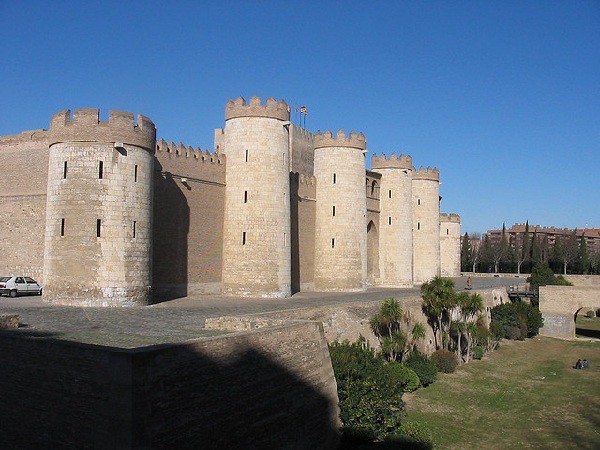
In Zaragoza we find a place emblematic for the legends and historical episodes that dwell within its walls. I am talking about the Aljafería Palace, also called Palace of Joy, a name given to it by Al-Muqtadir, king of the Taifa of Zaragoza between 1046 and 1081. Al-Muqtadir was the one who ordered its construction.
The significance of this palace-fortress lies above all in the fact that it is the only monument that survives and that displays the style of the Taifa period. The taifas were the divisions that took place in the Caliphate of Córdoba after the overthrow of the caliph Hishamm III.
The oldest element of the Palace of Joy is the Troubadour’s Tower (late 9th century), a defensive tower with a square floor plan and five storeys. It was mainly built as a watchtower and later integrated into the castle-palace. In 1486 it began to be used as a dungeon and prison. This function was maintained over time until the 19th century.
Its interior served as the residence of rulers from different periods: Muslims under Al-Muqtadir, Christians after the Reconquest by Alfonso I the Battler in 1118, when it became the residence of the kings of Aragon, later the arrival of Peter IV the Ceremonious, and finally the period of the Inquisition. In each of these periods, extensions and remodelling were carried out in the palace so that it could be adapted to the needs of each occupant.
Thus rooms were enlarged, churches were added, decorative elements were lost but others were gained, and even quarters were added to house the officials of the Inquisition. The result of all these changes has left, to the delight of visitors, tilework floors, ceilings, stucco work, arches and columns that transport the observer to past eras.
Source | Wikipedia
Photo | Flickr-Vic 15