The Miguelete and the Torres de Serranos, two symbols of Valencia
There are buildings that, thanks to the importance they held in history, end up becoming the banners or symbols of their cities. In Valencia we could talk about several elements of this kind. Among the more modern ones we find the constructions signed by Calatrava that give shape to the Oceanogràfic, the Museum of Sciences and L’Hemisfèric, among many others.
But today I want to tell you about constructions that accompanied and formed part of the life of the Valencians for many more years. The Bell Tower, known as the Miguelete, began construction in 1381 and took forty-eight years to complete. It stands 63 metres tall and has an octagonal floor plan. You can reach its highest point by climbing 207 steps. The climb can be challenging due to the wear on the steps and the narrowness of the route, especially in the last few metres.
The Miguelete still chimes the hours, although of course the bell-ringing system has been modernised. Thanks to restoration work, the Miguelete remains in perfect working order and is open to the public; tickets (2 euros) give access to the three chambers of the bell tower and the terrace.
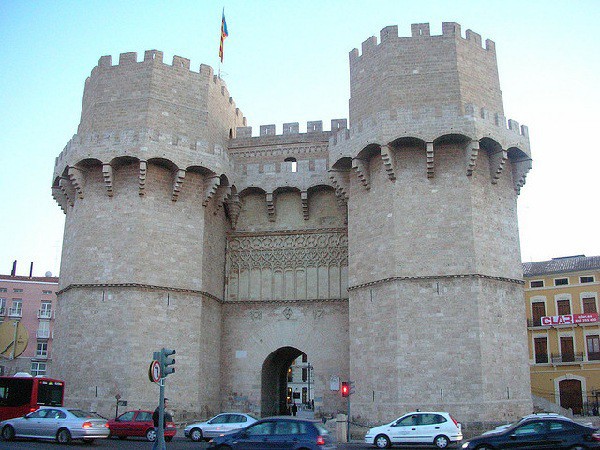
On the other hand, we have the Torres de Serranos, also restored and in perfect condition. The Towers gave access to the city when it was still walled. Pere Balaguer was commissioned to build the works, which began in 1392. The towers’ main use was defensive fortification, although they were later also used as a prison and even to house artworks from the Prado Museum during the Spanish Civil War.
Today the Torres de Serranos are a true symbol of the city of Valencia. One of their most popular uses is the cridá, the moment when the Fallera Major of Valencia starts the Fallas festivities. The Towers can be visited every day except Mondays, and admission is free. From the top there are wonderful views of the city.
Source | Wikipedia
Photo | Flickr-Puroticorico