The Valencia bridges designed by Calatrava
As you will see when you visit Valencia, the city is crossed by the former riverbed of the Turia River. This riverbed no longer carries water, and many of its areas have become places of leisure and culture. As a result, the city has a large number of bridges, both for pedestrians and for vehicles. Today I want to tell you about the bridges designed by the architect Santiago Calatrava, who has left his signature on many buildings in the city.
The first one he designed, in the 1980s, was the Puente del Nueve de Octubre, dedicated to the reconquest by James I. Although it is perhaps the least spectacular, the two sculptures shaped like eagles with outstretched wings that lead onto the bridge at each of its sides are still very original.
The Monteolivete bridge is one of the most recent. It divides the City of Arts and Sciences. To its right is the Museum of Sciences and the Hemisfèric. As in most of the buildings constructed in Valencia, the architect uses white and curved forms. The Pasarela de la Exposición is also known as La Peineta because of the curved shape of its inclined steel, which reaches a height of 14 metres.
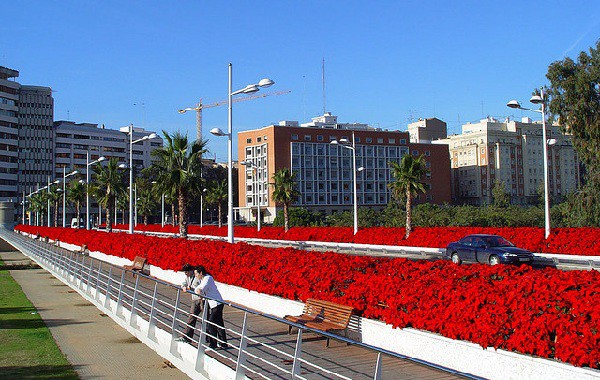
Finally, two bridges that have been somewhat controversial. The Puente de Las Flores has always been criticised (especially in these last years of crisis) for its high maintenance cost. Its design was meant to show that the words of the Valencian anthem are true: “Valencia is the land of flowers”. For this reason, thousands of planters holding flowers throughout the year were placed along its edges. Until quite recently, the flowers were changed three times a year, which meant an excessive expense. Recently it was decided to change them only once a year and to try to use very hardy flowers.
The last bridge, inaugurated in 2008, is the so-called Azud de Oro, as a tribute to the weirs that irrigated the Valencian orchards. It has a curved pylon 125 metres high with 29 cables that give it the shape of a harp. The controversy surrounding the bridge had to do with the queues of cars that formed when driving down from it, which led to some accidents. In the end, the problem was solved by installing traffic lights.
Source | LoveValencia
Photo | Flickr-Floresyplantas