First brushstrokes on Strasbourg
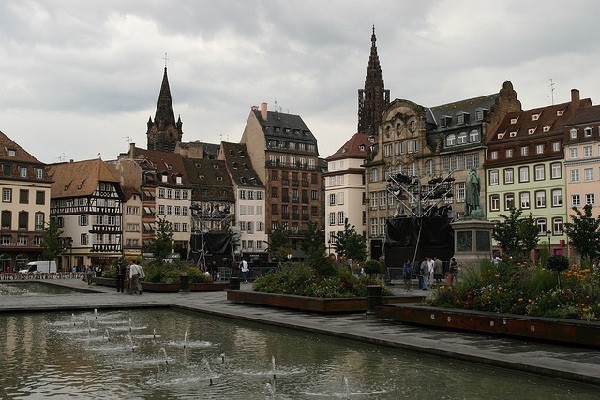
Strasbourg is a city located in the region of Alsace and its capital. The Romans, in the 12th century BC, were responsible for founding the first known city, called Argentoratum, establishing their camps there. From the 3rd century it became the administrative seat of the region, although later the power struggles over the city began. The Germans were the first to wrest power from the Romans, occupying the city in the year 406. From then on, Strasbourg changed hands between the Germans and the French until finally, after the First World War, Strasbourg became part of France again.
During the Second World War, Hitler’s troops occupied Strasbourg once more and suffered heavy bombing that destroyed much of the city. Finally, after the war ended, Strasbourg became a symbol of Franco-German reconciliation and was chosen as the seat of the Council of Europe in 1946. In fact, Strasbourg is home to several European Union buildings that bear witness to the importance the city had at the moments when a united Europe was pursued: the Council of Europe, the European Court of Human Rights, the Parliamentary Assembly of the Council of Europe, the European Ombudsman, the Eurocorps, and the European Parliament.
Traces of the passage of different cultures are reflected in the styles of the buildings, the streets and even the language, where besides French, German is also spoken perfectly. Due to the countless sieges the city suffered and the events and attacks by Allied troops during the war, buildings had to be rebuilt, so many combine different styles depending on the era.
After these brief brushstrokes on the history of Strasbourg, let us now get to know a little more of the city’s most emblematic places. One of the most beautiful places for tourists is its old town, the first to be declared a World Heritage Site, in 1988. This district is known as La Grande Île because it is crossed by the III river, a tributary of the Rhine, one of the most heavily trafficked rivers in Europe.
In this almost entirely pedestrian district is where we will find the most beautiful places in the city. Here is its popular Cathedral of Notre-Dame, a place of worship that for years held the distinction of being the tallest religious building thanks to its tower, which gives it a height of 142 metres. Also countless are its charming squares, where one can enjoy the passing of pedestrians or a good conversation over a drink or a good meal.
The palaces, the streets dedicated to former guilds and its black-and-white houses, typical of the houses located along the banks of the Rhine in Germany, also deserve an unhurried stroll. As you can see, to explore the city of Strasbourg we will need to devote more than one or two days of our holidays. Likewise, we will need to dedicate more than one article to delve into all of its places of interest.
Source | Wikipedia
Photo | Flickr-El Itinerante
2 comments · Comment
2 comments