Pampaneira, Bubión and Capileira: how to explore the Poqueira Gorge without repeating what has already been said about the Alpujarra
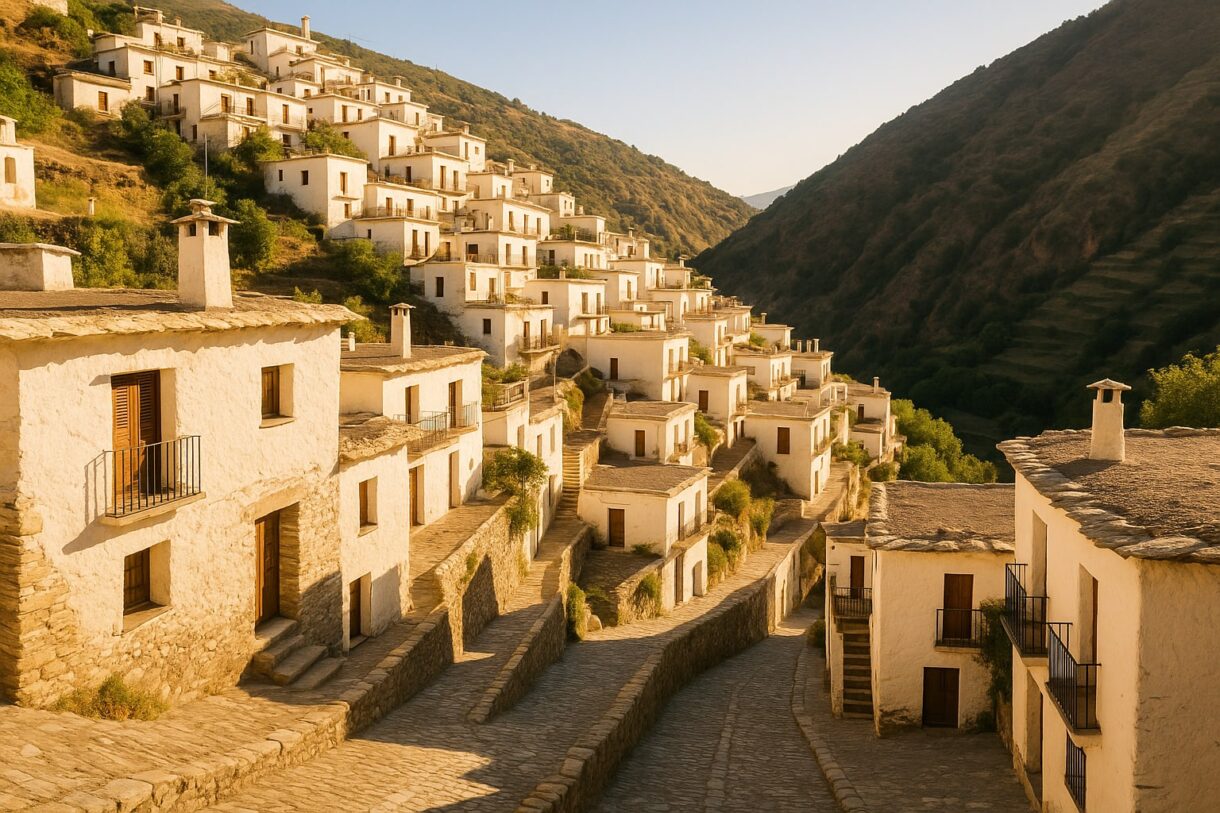
If you only have one day, stop in Pampaneira, have lunch there and drive up to Capileira to see the gorge from above. If you have two, sleep in Bubión or Capileira and leave Pampaneira for the morning of your return, when the coaches have not yet arrived. They are three villages strung along the same road (the A-4129) over barely six kilometres, but they each serve a different purpose: Pampaneira is the commercial gateway, Bubión the intermediate village-museum and Capileira the real base for high-mountain hiking.
This guide is for anyone who wants to explore the Poqueira Gorge without treating it as a theme park of rug shops. You will want to know which village the serious routes start from, where you can eat without a queue and why it is worth sleeping up high even if it means driving a narrow road at night.
What exactly the Poqueira Gorge is
The gorge is a glacial ravine carved out by the Poqueira River, a tributary of the Guadalfeo, on the southern slope of Sierra Nevada. The three villages cling to the western hillside at between 1,050 and 1,436 metres above sea level, within the Sierra Nevada National Park, and share an architecture of Berber origin: whitewashed houses, flat roofs of launa (grey, waterproof clay) and the characteristic tinaos, covered passageways that cross the streets.
The ensemble has been declared a Bien de Interés Cultural (Asset of Cultural Interest) since 1982 as a Historic Site of the Middle Alpujarra. The registered population is around 1,300 across the three villages, with Capileira in the lead. In August it multiplies by ten.
Quick overview of the three villages
| Village | Altitude | Approx. population | Main function | Best for |
|---|---|---|---|---|
| Pampaneira | 1,050 m | 320 | Commercial entrance, handicrafts | Eating and shopping |
| Bubión | 1,300 m | 300 | Intermediate village, less crowded | A quiet night’s sleep |
| Capileira | 1,436 m | 560 | High-altitude hiking base | Mountain routes |
Pampaneira: the entrance that absorbs coach tourism
It is the first you come across heading up from Órgiva and the one that concentrates commercial activity. The Plaza de la Libertad, with the church of Santa Cruz at the far end (16th century, Mudéjar) and the continuous pillars where dogs still drink, is the standard postcard image of the Alpujarra. Around it, a dozen shops selling jarapas (rag rugs woven on a loom), artisan chocolates and cured meats from Trevélez.
If you arrive by coach or organised excursion, this is where you get dropped off. That means queues at the two or three most visible restaurants at midday and narrow pavements packed between 11:00 and 15:00. The upside: parking is easier than further up (there is a free car park at the entrance) and services are concentrated here.
For lunch, Casa Diego on the square works well with unpretentious Alpujarran dishes; the plato alpujarreño (loin, longaniza sausage, black pudding, egg, home-style potatoes and pepper) costs around €12–15. If you prefer something lighter, the tapas at Bodega El Lagar include Trevélez ham with village bread for the price of a small beer (€2–2.50).
Bubión: the intermediate village that almost everyone skips
It sits 250 metres higher and, paradoxically, is the least visited of the three. Most excursions do Pampaneira below and Capileira above, skipping Bubión. For you, that is good news.
Here you will find the Casa Alpujarreña, a small ethnographic museum set up in a traditional 18th-century house. It shows how a launa house was organised inside: the kitchen with its conical chimney, the loom, the farm tools. Admission is around €2, open at weekends and public holidays; check the times beforehand because the town hall runs it with reduced hours.
Bubión has fewer shops and more genuine workshops: pottery, and an active loom at the Taller del Telar (you can watch the jarapas being made, not just buy them). The church of the Virgen del Rosario, also Mudéjar from the 16th century, is usually closed except for Mass.
For sleeping, it strikes the right balance: quiet nights, five minutes by car from both Pampaneira and Capileira, and slightly better prices than up above.
Capileira: the base for high mountain hiking
It is the highest of the three and one of the highest villages in Spain. The serious routes of the Poqueira Gorge start from here and, in summer, the high-summit interpretation service, a national park minibus that climbs to the Hoya del Portillo (around 2,150 m) and, depending on the season, to the Trevélez Viewpoint or the Alto del Chorrillo refuge (around 2,700 m), from where you can reach the Mulhacén (3,479 m) by its southern face in a long day.
The bus usually runs from mid-June to early October, requires advance booking at the Capileira Information Point and costs between €10 and €15 return. It is the only motorised way up: private vehicle access has been closed to the public since the nineties.
Capileira has more rural accommodation than the other two and services open all year round (pharmacy, two small supermarkets, four or five restaurants active in winter). The Mesón Poqueira and La Taberna de Isabel keep cooking fennel stews and garlic goat in the cold season, when the villages regain some of the pulse they lose in summer.
Hiking: which route starts from where
The GR-7, a long-distance trail that crosses Europe from Tarifa to Athens, links the three villages. Between Pampaneira and Capileira it takes about two and a half hours on foot along mule tracks, with a cumulative ascent of around 400 metres. It is the honest way to get to know the gorge: you see the irrigation channels of Nasrid origin, the maize terraces and the chestnut trees.
| Route | Start | Duration | Difficulty |
|---|---|---|---|
| GR-7 Pampaneira–Capileira | Pampaneira | 2.5–3 h | Medium |
| Short loop of the Poqueira | Capileira | 3–4 h | Medium |
| Cebadilla (power station) | Capileira | 4–5 h | Medium |
| Mulhacén via the southern face | Capileira (by bus) | 7–9 h | High |
| La Cebadilla–Poqueira Refuge | Capileira | 5–6 h | High |
The Poqueira Refuge (2,500 m), run by the Andalusian Mountaineering Federation, is the base for anyone who wants to do the Mulhacén over two days. Booking is essential; half board costs around €35–45 depending on the season.
Getting there and getting around
From Granada: about 70 km along the A-44 to Lanjarón, then the A-348 and A-4129. By car it takes 1 h 15–1 h 30. There is a daily Alsa bus from Granada’s bus station with stops in all three villages; the full journey takes around 3 hours and the ticket costs €7–9.
From Málaga: 2 h 30 by car via the A-7 and A-44.
Between the three villages you can get around on foot (steep but feasible), by your own car (watch out for parking, which is limited and in summer has blue-zone restrictions in Capileira) or on the same Alsa bus, which runs the Órgiva–Capileira line several times a day.
If you are coming without a car, Capileira is the best base: it has the high-summit bus, more connections and services open in winter.
When to go (and when not to)
May–June and September–October are the ideal months: mild temperatures (15–25 °C by day), dry trails, villages alive but not overrun. July and August multiply the visitors, especially at weekends; if you go in August, sleep there so you can enjoy the villages at dawn and dusk, when the coaches have already left.
Winter (December–March) has its own charm: occasional snow on the roofs, fires lit in the chimneys, lower prices. Capileira can be cut off for a couple of days if heavy snow falls. The high routes are closed or require winter equipment.
If you are interested in this kind of mountain architecture with its own identity, there are interesting parallels with the Pyrenean valleys of Ansó and Hecho, where Chesu is still spoken: another rural Spain that endures through its own language and crafts.
What to eat with a proper name
- Plato alpujarreño: rustic fare served as a generous portion. Always with home-style potatoes.
- Jamón de Trevélez (PGI): cured at 1,476 m in the neighbouring village. Ask for it hand-carved, not machine-sliced.
- Choto al ajillo: young goat kid stewed with garlic, typical in winter.
- Migas alpujarreñas: with sardines, pepper and grapes.
- Coastal wine: red from Albondón or Albuñol, light and little known outside the area.
- Alfacar bread: it is not from here but arrives fresh every morning.
The chocolates from Pampaneira (Abuela Ili, with unconventional flavours such as fig and almond) make an honest souvenir; they are not the village’s traditional dessert but they are genuine local production.
Common mistakes
- Doing all three villages in two hours. That gives you time to see the squares and little more. Set aside at least half a day if you want to go into a workshop or museum.
- Sleeping in Granada and only going up for lunch. You miss the best part: the villages empty at first light and after 19:00.
- Trying to climb the Mulhacén from Capileira without booking the bus in advance. In July and August it sells out days ahead.
- Wearing urban trainers. The streets are cobbled, steep and slippery in the rain.
- Confusing “Alpujarran craftwork” with local production. Check the label; much of the rugs sold in shops come from elsewhere.
Where to sleep according to your profile
| Profile | Recommended village | Approx. price for a double |
|---|---|---|
| Couple, a quiet getaway | Bubión | €60–90 |
| Hiker, several days | Capileira | €55–85 |
| Family with children | Capileira (more services) | €70–110 |
| Short visit, arriving late | Pampaneira | €50–80 |
These are mid-season ranges; August and Holy Week rise by between 20 and 40%.
Frequently asked questions
How many days do I need for the Poqueira Gorge? One day is enough to see the three villages superficially. Two days allow you to sleep up high and do a half-day route. Three days is reasonable if you want to climb to the summits or combine it with Trevélez and the Almerían Alpujarra.
Can you climb the Mulhacén from Capileira in one day? Yes, using the national park bus to the Alto del Chorrillo. From there it is around 3–4 hours up and 2–3 hours down. You need to book the bus in advance and carry water, sun protection and warm clothing even in August.
Are there cash machines and a petrol station? A cash machine in Pampaneira and Capileira. No petrol station: the nearest is in Órgiva, 15 km below. Fill up before you head up.
Is it suitable for children? Yes, especially Capileira for its services and Bubión for its quieter streets. The long routes are not, but short walks along the irrigation channels work well. The high-summit bus accepts children.
Which village has the best connections in winter? Capileira keeps more services open all year. Pampaneira also works well, being lower down. Bubión offers fewer options on weekdays in the low season.
Is it worth going in August? Yes, but sleeping there. If you are just passing through on a Saturday in August, you will find all three villages crowded between 12:00 and 17:00.
If you have to choose just one night, sleep in Capileira and get up early to do the stretch of the GR-7 descending to Pampaneira before 10:00. Have breakfast up high, walk two and a half hours down the gorge with the river sounding on your left, and reach Pampaneira in time for a drink in the square before the coaches arrive. It is the most honest way to understand why these three villages, squeezed together, are not the same village.
Places of Interest Leisure and Culture #Barranco de Poqueira #Guía de viaje #pueblos con encanto #senderismo #Sierra Nevada #Turismo rural

 Don't get fooled: plan your trip well and avoid these scams on your holidays
 Central Macedonia, the destination Spaniards have discovered to fall in love with Greece
 Summer in Brussels: flowers, festivals and typical gastronomy
Comentarios cerrados