Setenil de las Bodegas: living under the rock in the Sierra de Cádiz
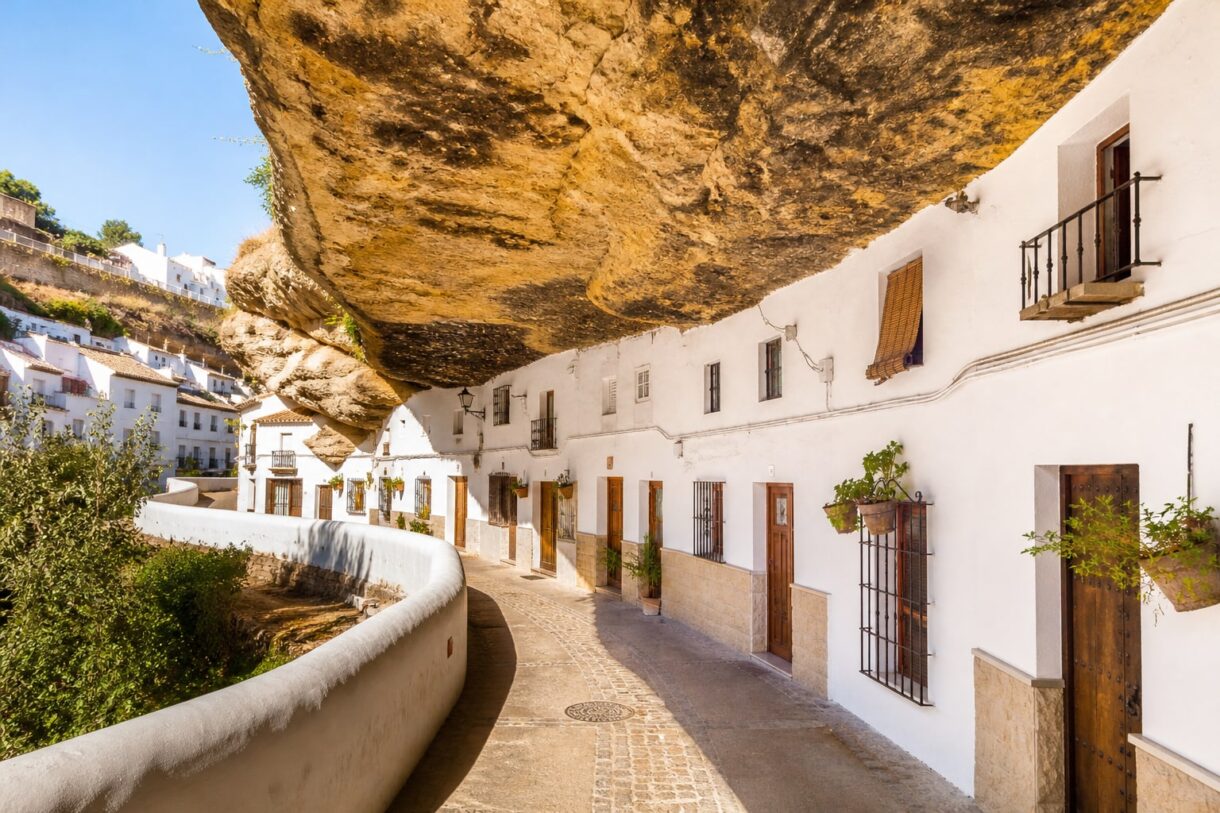
If you have a free day in the Sierra de Cádiz and are torn between several white villages, Setenil is worth the detour for one specific reason: it is not a village with houses under the rock, it is a village built inside the rock. The homes on Cuevas del Sol and Cuevas de la Sombra streets use the overhang of the Trejo river gorge as a natural roof, and this is not repeated in any other place along the route.
This article is useful if you are going to spend anywhere from three hours to a full day, whether coming from Ronda (about 20 km), from Málaga city, or linking it with Grazalema and Zahara. It is not a destination for staying a week: it is an intense, highly photogenic visit with mountain cuisine that justifies booking a table.
Quick facts about Setenil de las Bodegas
| Detail | Value |
|---|---|
| Province | Cádiz (Sierra de Cádiz region) |
| Population | approx. 2,700 |
| Altitude | about 640 m |
| Distance to Ronda | approx. 20 km |
| Distance to Málaga | approx. 125 km |
| Origin of the name | from Latin septem nihil (“seven times nothing”) |
| Christian Reconquest | 1484, by the Catholic Monarchs |
| Main festival | Feria de San Sebastián (January) and Holy Week |
Why the houses are set under the rock
The explanation is not mysterious: it is geology and common sense. The Trejo river carved a gorge of tufa limestone over millennia, producing large horizontal overhangs in the walls. When the village grew after the Castilian capture of 1484, residents used these natural eaves as roofs and closed the front with whitewashed facades. The result is a functional troglodyte architecture: cool in summer, mild in winter, and free in terms of roofing.
The place name “Setenil” comes, according to tradition, from septem nihil (“seven times nothing”), in reference to the seven sieges the Christians needed to take the Nasrid fortress. The surname “de las Bodegas” came later, when the region produced wine in quantity; the phylloxera of the 19th century destroyed almost all the vineyards, but the excavated cellars remain, today converted into bars and storerooms.
What to see in Setenil in one day: walking route
The historic quarter can be walked in two or three hours without rushing. The logical itinerary starts at the top and descends to the river.
- Castle and Keep (Torre del Homenaje). Of Almohad origin, it is what remains of the Nasrid fortress. Entry around €2–3; from the top you can understand the layout of the gorge.
- Church of Nuestra Señora de la Encarnación. Built over the former mosque after the Reconquest, Gothic-Mudéjar style with a 16th-century altarpiece.
- Mirador del Carmen. The classic postcard view: the village wedged into the bend of the river.
- Cuevas del Sol street. The most photographed. The rock forms a continuous overhang above the bar terraces.
- Cuevas de la Sombra street. On the opposite bank, narrower and darker; here the rock falls almost vertically over your head.
- Jabonería and Herrería streets. What remains of the artisan Setenil, less travelled.
If you have spare time, go up to the Mirador del Lizón early in the morning to see how the light enters the gorge.
How to get there: from Málaga, Seville and Ronda
There is no railway station in Setenil. The nearest rail stop is in Ronda, on the Algeciras–Bobadilla line, and from there you must continue by car or regional bus (the company Los Amarillos covers the area, with limited frequencies; it is advisable to check timetables on the operator’s website before travelling).
By car, the approximate times are:
| Origin | Distance | Driving time |
|---|---|---|
| Ronda | 20 km | 25–30 min |
| Málaga | 125 km | approx. 1 h 45 min |
| Seville | 135 km | approx. 1 h 45 min |
| Cádiz | 150 km | approx. 2 h |
| Jerez | 100 km | approx. 1 h 30 min |
Park in the signposted car parks at the entrance to the village (free or low-cost, around €1–2 per day). Driving into the old town is a bad idea: streets are narrow, steep and often blocked.
When to go: avoid August at midday
Setenil is small and has become popular. In July and August, between 12:00 and 17:00, Cuevas del Sol and Cuevas de la Sombra streets fill with organised tours and the dry heat of the Andalusian interior is intense (easily 35–38 °C). If summer is your only option, arrive early in the morning or at the end of the afternoon.
The best seasons are spring (April–May) and autumn (October–November): mild temperatures, good light for photography and less tourist pressure. In January the Feria de San Sebastián, the village patron, takes place, with local activities away from the tourist circuit. Holy Week has processions that descend through impossibly narrow streets.
Where to eat: cured meats, retinto beef and tagarninas
The cuisine of Setenil is mountain food without pretension. What to look for on the menu:
- Homemade cured meats from pork, especially chorizo and lomo in lard.
- Retinto beef, an indigenous Cádiz breed, grilled or stewed.
- Asparagus tagarninas, a wild thistle typical of the sierra.
- Sopa cortijera or warm gazpacho in winter.
- Toast with olive oil from the neighbouring countryside, for breakfast.
The bars with tables under the rock on Cuevas del Sol are the most sought after; they are reasonably good but charge for the location. To eat with fewer crowds and a fair price, go one street further up. A set lunch menu is around €12–15; a à la carte meal with wine, €25–35 per person. Book at weekends.
If you are interested in the wine culture associated with these villages, the parallel with other excavated wine-cellar settlements is clear: just as in Laguardia, with its cellars beneath the houses of Rioja Alavesa, where wine is still the engine, here it has remained as memory.
Staying overnight in Setenil or visiting for the day
Most travellers visit Setenil on a day trip from Ronda, and this is a sensible decision: Ronda offers more hotels, more restaurants and more to see in the evening. But sleeping in Setenil has its reward: the village empties after 19:00 and the streets under the rock are left to residents.
There are rural guesthouses and small hotels in the old quarter, several installed in former cave dwellings. Indicative prices for a double room: €60–110 per night in mid-season; they rise on bridge weekends and during Holy Week. Book well in advance: the supply is limited.
Setenil within the White Villages Route
Setenil is part of the classic itinerary alongside Grazalema, Zahara de la Sierra, Olvera, Ubrique, Arcos de la Frontera and Vejer. Do not try to see them all in one day: two or three per day is a reasonable pace if you want to get out of the car and explore the villages.
An effective combination for 24 hours from Ronda:
- Morning: Setenil (3 h, including an early lunch).
- Afternoon: Olvera (castle and collegiate church) + Zahara de la Sierra (reservoir and viewpoint).
If you are drawn to villages wedged into mountain landscapes, the approach is similar to other settlements in southern Spain such as Pampaneira, Bubión and Capileira in the Granada Alpujarra, although there the Berber-style chimneys dominate and here it is the rock.
Common visitor mistakes
- Going at midday in August. The village becomes congested and photos come out full of heads.
- Trying to drive into the old town. It doesn’t fit and you risk a fine.
- Seeing it in 45 minutes. You walk the two famous streets and leave without visiting the castle or the church.
- Not booking a restaurant at the weekend. The bars under the rock fill up early.
- Confusing it with Ronda. They are different villages; Setenil has no new bridge or bullring.
Safety and accessibility
Setenil is a quiet village with no notable safety problems. The risks are different: steep streets, uneven cobbles and steps. It is not a comfortable destination for wheelchairs or large pushchairs. Wear shoes with good grip; in winter, when it rains, the ground becomes slippery.
In summer, bring a water bottle and a cap: there is little shade outside the streets covered by the rock.
Frequently asked questions
How much time do I need to visit Setenil de las Bodegas? Between 3 and 4 hours is enough to see the castle, the church, the viewpoints and to eat on a terrace under the rock. If you go at a relaxed pace and step into a shop, allow half a day.
Can I get to Setenil by public transport from Málaga? It is possible but not very practical. The most reasonable option is train or bus to Ronda and from there the regional bus (limited frequencies) or a taxi. With a rental car you save a lot of time.
Are the houses under the rock still inhabited? Yes. Many are private homes, in addition to bars and shops. Respect privacy: do not peek through open doors or photograph interiors without permission.
Is it free to enter Setenil? The village itself is free. You only pay to visit the castle (around €2–3) and, occasionally, for specific exhibitions. Parking in the car parks at the entrance costs €1–2.
Setenil or Ronda if I can only see one? For a first visit to the Sierra de Cádiz, Ronda offers more monumental content (new bridge, bullring, extensive old town). Setenil is a complementary half-day visit, not a substitute.
Are there cash machines and supermarkets? Yes, in the new village there are cash machines, a pharmacy and small supermarkets. In the historic quarter it is better to carry small cash: not all bars accept cards for small purchases.
If you go in spring and start from Ronda, leave at 9:00, reach Setenil before 10:00, do the full route at a relaxed pace, eat early (14:00) on a terrace on Cuevas del Sol with a prior booking and, before the bulk of the coaches arrive, continue on to Zahara de la Sierra. You will see the village as it deserves to be seen: with the rock over your head and without having to wait your turn for a photograph.
Places of Interest Leisure and Culture #arquitectura #cuevas #Escapadas #Guía de viaje #pueblos con encanto #Sierra de Cádiz


 Don't get fooled: plan your trip well and avoid these scams on your holidays
 Central Macedonia, the destination Spaniards have discovered to fall in love with Greece
 Summer in Brussels: flowers, festivals and typical gastronomy