The Befreiungshalle monument in the city of Kelheim
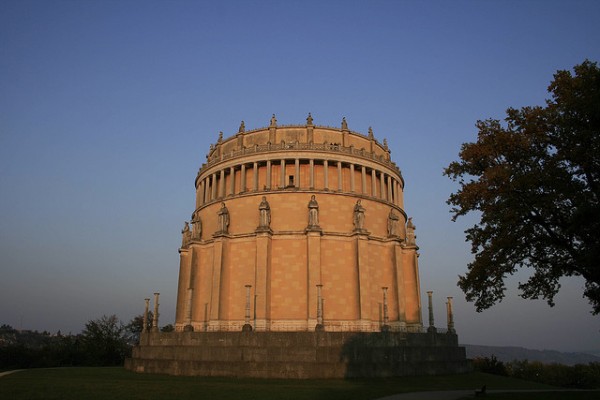
At the confluence of the Danube and Altmühl rivers lies the city of Kelheim, in the state of Bavaria. Its origins date back to the 7th century, and from the 12th century onward it became an important trading center for wine, salt, fish, livestock, stone and timber. In addition, it is home to the oldest white beer brewery in the state of Bavaria, founded in 1607. A small town with a great deal of historical interest.
But if the city of Kelheim stands out for anything, it is for the monument located on Michelsberg Hill. The Befreiungshalle, or Hall of Liberation, is a neoclassical building. Its construction began in 1842 and lasted a little over 20 years. It was finally inaugurated in October 1863, coinciding with the 50th anniversary of the Battle of the Nations, near Leipzig.
The construction of the Befreiungshalle was ordered by King Ludwig I of Bavaria to commemorate the victories achieved by Bavaria in the Napoleonic Wars, between 1813 and 1815. A blend of classical and Christian styles shaped its construction, in addition to some alterations made during the just over twenty years it took to build.
Its façade has 18 columns, guarded by 18 statues that symbolize the struggle of the German army in the Napoleonic Wars. Inside, there is a hall 29 meters in diameter. Both inside and outside, there are details that King Ludwig I wanted included so that the commemorative spirit of the building would endure through the centuries.
On the marble floor that lights the central hall, one can read a series of phrases written by Ludwig I, which served to emphasize the building’s symbolism. They read as follows: “Moechten die teutschen nie vergessen was den befreiungskampf nothwendig machte und wodurch sie gesiegt”, which translated into our language means “May the Germans never forget what made the struggle for liberation necessary and how they won.”
Likewise, on the door of the beautifully decorated main façade, another inscription, quite similar and with the same theme as the one inside, reads: “Den teutschen befreiungskaempfern Ludwig I, Koenig Von Bayern”, whose meaning is “To the German freedom fighters, Ludwig I, King of Bavaria.”
Despite the architectural simplicity this monument may seem to have at first sight, the Befreiungshalle bases its importance on the symbol it represents for the German people in their struggle against Napoleon’s troops. One more chapter in the long history of the German people.
Source | Wikipedia
Photo | Flickr – Poll Sebastian

1 comment · Comment
1 comment