The House of World Cultures in Berlin
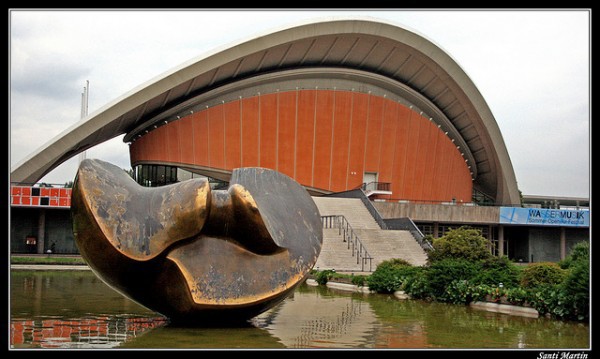 One of the most emblematic buildings of the city of Berlin is located on John-Foster-Dulles-Allee, right in the Tiergarten park. The House of World Cultures is also known as the “Pregnant Oyster” because of its exterior design. An impeccable building where the cultures of the whole planet have their place to be showcased.
It was built in 1957 by the American architect Hugo Stubbins, and was financed in part by the United States, mainly as a sign of friendship between the German and American peoples. One of the curiosities of its structure is the roof, open in two directions, giving the impression that it is floating. This roof partially collapsed in 1980 and was rebuilt over the original in 1987, on the occasion of the 750th anniversary of the city of Berlin.
It was initially known as the old Berlin Congress Hall, but since 1989 it has been called the House of World Cultures, above all because of the various cultural events held there. Also on the occasion of the city’s 750th anniversary, the Carillon was inaugurated in 1987: four towers covered by a roof, and at its center hangs the largest carillon in Europe, with 68 bells.
This building promotes cultural events related to dance, music, theatre, cinema, with the participation of artists from all continents, especially Latin America. Throughout the year, performances, exhibitions and events related to the world of culture take place. In November alone, one can attend events such as a Youth Theatre Festival, the Premiere Brasil 2012 film screening, WorldTronics concerts, or amateur architecture events. Disciplines from all over the world to choose from for every visitor throughout the year.
Near the building, we can stay in 5-star hotels such as the Hotel Mandala or the Berlin Marriott, very close to the area of influence of the Pregnant Oyster. From 10 in the morning to 7 in the evening, every day, the building has its doors open to anyone who wishes to visit it. Exhibitions are scheduled from Wednesday to Monday, from 11 in the morning to 7 in the evening.
To encounter the diversity of world cultures, what better place than a house designed for it. The House of World Cultures is the place where we all speak the same language, that of harmony and knowledge.
Via | hkw.de
Photo | flickr-santi martin