Piazza del Popolo in Rome
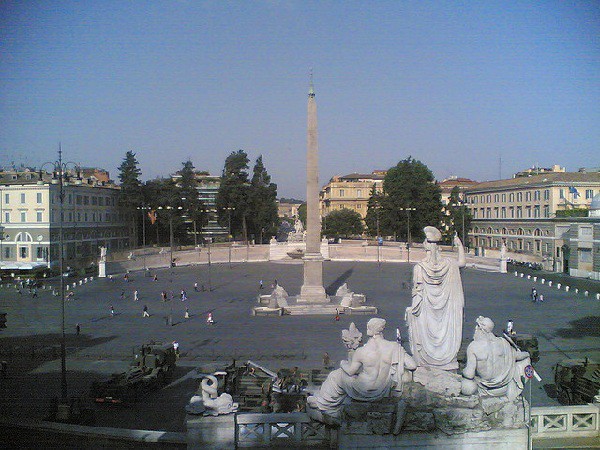
One of the most visited squares by tourists passing through the city of Rome is the Piazza del Popolo, or “People’s Square” in English. It is not known for certain whether its name is related to the nearby Church of Santa Maria del Popolo or whether it refers to the large number of poplar trees in the area, since poplar in Italian is pioppo and in Latin populus.
The architect Giuseppe Valadier was responsible for designing this square in neoclassical style between 1811 and 1822. To carry out his project, other buildings had to be demolished to achieve its circular shape. Its main feature is the obelisk that rises at the centre of the square. It is one of the oldest and tallest in Rome: a 24-metre obelisk that was brought from Heliopolis (an ancient Egyptian city) and that honoured Ramesses II.
In fact, originally the centre of the square was occupied by a fountain, since the obelisk stood in the Circus Maximus. In 1589 it was decided to move the obelisk to the square, and later the original fountain was also moved to make way for other fountains of Egyptian inspiration placed at the base of the obelisk.
Perhaps one of the reasons tourists choose this square as a meeting point is that some of the city’s most important streets leave from it: Via del Corso, Via del Babuino and Via di Ripetta. Other notable buildings or places of interest in the area are the twin churches in Baroque style. You will also come across the Porta Flaminia, which was part of the Aurelian Walls and is now known as the Porta del Popolo.
Source | Wikipedia
Photo | Flickr-Cebete
2 comments · Comment
2 comments