The Pergamon Museum in Berlin
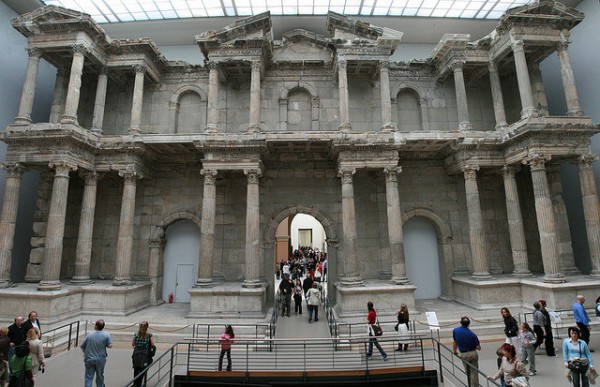
In a previous post, you were able to see firsthand a cultural complex in the city of Berlin called Museum Island. A place where we can find a series of very famous museums of great historical value. Within this complex, we highlight one of its venues: the Pergamon Museum.
Construction of this museum began in 1910 and, twenty years later, in 1930, it was completed. Curiously, it was not a building originally constructed to house works of art; rather, the works arrived in the area first and the building was then erected around them. Many of them, being architectural in nature, make up the walls and columns of the museum itself.
Among these works, which arrived before the museum was built and are now part of it, we can find the Pergamon Altar, the Market Gate of Miletus and the Ishtar Gate of Babylon, all with parts that were transported from the original excavation site.
It is worth highlighting the areas into which the museum is divided, showcasing works of art from different regions of the world. The most impressive are the sections dedicated to Islam, Rome, Greece and the Hellenistic period, which includes the city of Pergamon (which gives the museum its name), as well as Mesopotamia and the Near East. Three museums are included within one: the Collection of Antiquities (Antikensammlung), the Museum of Islamic Art (Museum für Islamische Kunst) and the Museum of the Middle East (Vorderasiatisches Museum).
Within each of them there are pieces of great value for visitors. In the Collection of Antiquities we find works such as the aforementioned Pergamon Altar, the Mshatta Facade and Greek statues such as the famous Spinario, as well as the aforementioned Market Gate of Miletus.
The Museum of the Middle East displays, as its centerpiece, the Ishtar Gate, one of the eight that make up the inner wall of Babylon. We can also see a model of the Tower of Babel and a copy of the Code of Hammurabi. Relics found in excavations carried out in Iraq, Syria and Turkey by German archaeologists are also exhibited throughout the fourteen rooms that make up this museum.
Finally, in the Museum of Islamic Art, we can visit a wooden room called the Aleppo Room and a variety of walls decorated with ceramics. To name one of these, we highlight the prayer niches of Kolya.
This wonder of the Pergamon Museum is located, as mentioned above, on Museum Island, on Am Kupfergraben in Berlin. Around 850,000 people visit it each year and it is an essential stop for anyone spending their holidays in the German capital.
Via | guiadealemania
Photo | flickr-RamiroSanchezCrespo

1 comment · Comment
1 comment