Cueva de las Manos
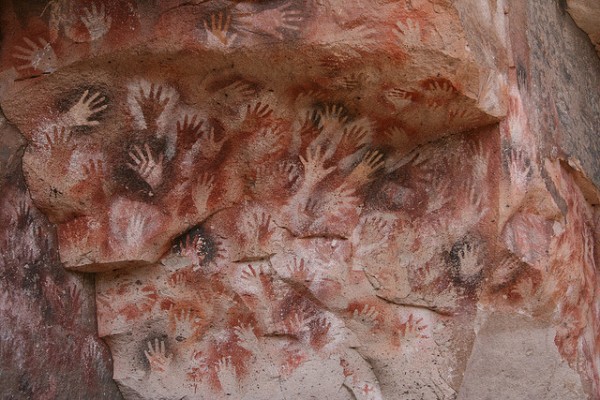
This particular archaeological site allows us to learn about some cave paintings found in the Lago Buenos Aires Department in the western part of the Province of Santa Cruz, Argentine Patagonia.
These paintings are very beautiful and interesting; they were created around 7350 BC. Without a doubt, they are one of the oldest artistic expressions in South America, and they have been declared a World Heritage Site by UNESCO.
These paintings form part of a group of American archaeological sites, a group that also includes Monte Verde in Chile, Pedra Furada in Brazil, and Piedra Museo in Argentina.
Although the cave was already known to travelers of the 19th century, it was not until the 1960s (20th century) that research was carried out showing that the inhabitants of the area lived by hunting and gathering plants. Besides the painted hands, shapes resembling ovals, circles, and stars were also found in the cave.
It is believed that, in fact, to create the paintings the inhabitants pressed their hands against the ceiling and walls and then covered them with paint.
On the various overhangs and walls of the caves one can see different figures representing elements of everyday life of the Tehuelche Indians and their ancestors. The best known is that of the hands; as many as 829 different hands were counted. Silhouettes of various animals can also be seen in scenes that would represent the collective hunting of animals.
Among the most used colors are red, ochre, yellow, white, and black. The shades were obtained from ground fruits, plants, and rocks. According to Fraser’s classification, the blood and fat of the hunted animals were also used as a binder.
Source | Wikipedia
Photo | Flickr – Niquinho

2 comments · Comment
2 comments