Ávila, walled city
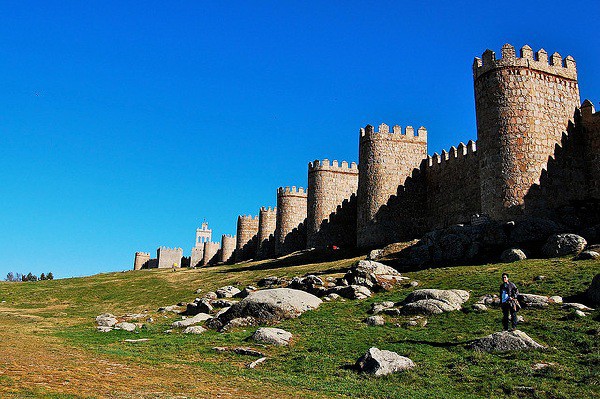
You don’t need to enter the city of Ávila to know you’re going to love it. Even from the road you can sense that its streets will give off an atmosphere that will transport you back to medieval times. The walls of Ávila set the scene for the visitor; they are its calling card, welcoming you with majesty and pride.
As you may have guessed, one of the city’s icons is the 11th-century walls, whose construction was commissioned by King Alfonso VI of Castile. According to traditional historiography, they took nine years to build, but many researchers do not find it credible that they were built in such a short time, so they favor the theory that some remains of a Roman wall already existed. In fact, some stones from the Roman period can still be seen in the walls.
They enclose a perimeter of more than two kilometers around the city, with 88 towers and 9 gates. The walls are 3 meters thick and up to twelve meters high, since in some areas the slope of the terrain was used during construction. They can boast of being the best-preserved walls in Spain. The two most popular entrances are the Alcázar Gate and the San Vicente Gate. You can enjoy them either by walking along the outside or by paying an entrance fee of 4 euros (which is worth it) and walking along the wall-walk, the patrol path. From there you’ll have beautiful views of the city.
However, the city was not granted World Heritage status for its walls alone, but also for its churches and its old town. So if you want to appreciate the beauty of the city, you’ll have to take a stroll through its narrow streets and, of course, try one of its typical dishes in its restaurants. Just be sure to wrap up warm if you visit in the autumn or winter months, because it gets bitterly cold.
Source | Walls of Ávila
Photo | Flickr-Allan Reyes
2 comments · Comment
2 comments