Getting to know Marseille (II)
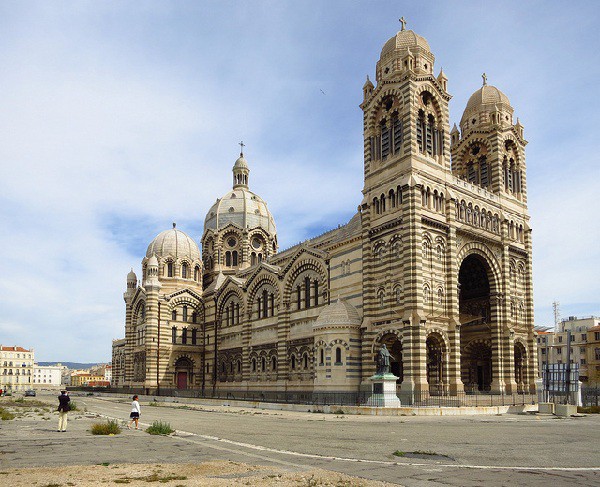
A few days ago we took a short tour of the ports and museums of Marseille. Today we are going to take a stroll past the most interesting monuments and buildings in the city. We will start with Notre-Dame de la Garde, an iconic basilica known as “The Good Mother”. It is located south of the Old Port and is a work in the Romanesque-Byzantine style. Its most striking feature is the gilded statue of the Virgin Mary, eleven metres tall, which crowns the bell tower.
Also in the Old Port area we find the forts that once guarded it: Fort Saint-Jean and Fort Saint-Nicolas. These defensive structures came to prominence from the 12th century onwards, in the case of Saint-Jean, when it became home to the Knights Hospitaller of St John of Jerusalem. Saint-Nicolas became better known for the Fronde uprising of the 17th century.
The Palais Longchamp was inaugurated in 1869 to commemorate the arrival of water in the city thanks to the canal works that began in 1839. It currently houses the Museum of Natural History and the Museum of Fine Arts.
The Basilica of Santa Maria Major is also a Romanesque-Byzantine building and perhaps one of the most photographed by tourists. It consists of two churches: the older one dates from the 5th century, although it was later restored, and the second is from the 19th century. To visit all these monuments quickly, we need only board the city’s tourist trains. These little trains may be considered part of “tacky” tourism, but the truth is they can be very useful for getting an overview of the city.
Finally, a special mention for the “Le Panier” district, where you will find a great number of craft shops and local products such as chocolate. And if you have the chance, a visit to the Frioul archipelago is also recommended. It is made up of four islands: If, Pomegues, Ratonneau and Tiboulen. The best known is perhaps If, for its Castle, which inspired Alexandre Dumas to write “The Count of Monte Cristo”. But any of them will be a good place to admire the beauty of the sea and the steep coves.
Source | Wikipedia
Photo | Flickr-Dodvan
1 comment · Comment
1 comment