Szeged, main center of the food industry
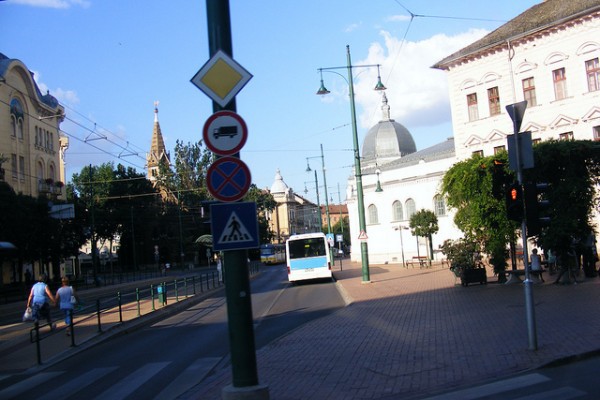 The fourth largest city in Hungary is located in the southeast of the country and is the most important one in this area. Just south of the confluence of the Maros River, it is also known as the City of Sunshine, due to the high number of sunshine hours it enjoys each year. This is the city of Szeged.
The history of Szeged dates back to the 12th century, with the movement of boats along the Maros River, transporting salt, being of vital importance, which favored the city commercially and economically. In the following centuries, it kept developing until it reached considerable importance from the 14th century onward, also becoming a strategic point in the face of a possible invasion by the Ottoman Turkish army.
Today, Szeged is one of the main centers of the food industry in all of Hungary. Above all, it is very famous for its well-known paprika and its varieties of it, such as Szekelygulyas, Halaszle Szegedi and Pick Salami. Without a doubt, it is one of the most interesting places in Hungary to discover an important part of its gastronomy.
Among the city’s main places of interest, we must highlight, in terms of education, the University of Szeged, probably the best in Hungary and one of the hundred most important in Europe. Within education, we should also highlight the Biological Research Centre of the Hungarian Academy of Sciences, a place that has been a strong source of advanced research.
Another of the most cultural places to visit in Szeged is the Votive Church of Our Lady of Hungary, the fourth largest church in Hungary, located in the city centre, with a 54-metre-high dome and two 91-metre-high towers, one of which houses the so-called “Bell of the Heroes”, weighing 8600 kg.
The technological monument, the Water Tower, is located in St. Stephen’s Square. This modern construction, made of reinforced concrete since 1904, was designed for water storage. It is worth visiting, especially at night, for its spectacular light show.
The Ferenc Mora Museum was built in 1896 in neoclassical style and is also the city’s first museum. The museum’s director, the novelist, journalist and museologist Ferenc Mora, expanded the various existing collections in the museum, giving it greater splendour that has survived to the present day. Above all, the painting exhibitions stand out, reflecting much of Hungarian history, daily life and landscapes.
We cannot fail to mention the National Theatre of Szeged, built in 1883 in eclectic and neo-baroque style. Numerous works began to be staged in this theatre from the 19th century onward, due to the considerable increase in population. Subsequently, extensions were made to the performance halls to meet the demand.
And in terms of hotels, we can highlight the Novotel Szeged, which is located close to the city’s central square but not in the centre itself (on Maros Street), which gives greater peace and quiet during our stay, with magnificent views over the river.
Source | Wikipedia
Photo | Flickr-HatM
5 comments · Comment
5 comments