Linderhof Palace in Bavaria
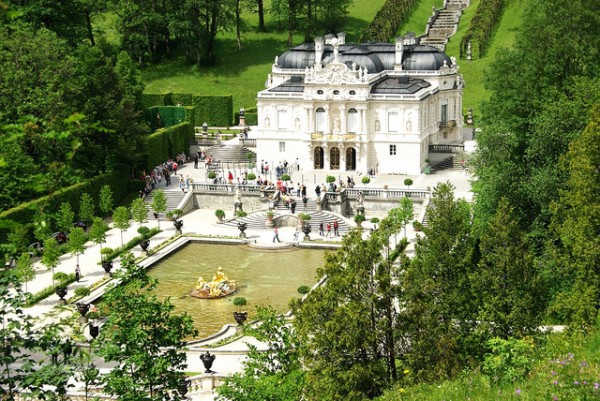
An endless parade of palaces and castles makes Germany a truly monumental and historic country. Today we are going to stop at one more of the many that stand out in the Bavarian state. For this, we will focus on the region of Bavaria. We are going to visit Linderhof Palace.
Built in 1870 on the orders of the legendary King Ludwig II, this palace stands in a valley near the town of Oberammergau, in the state of Bavaria. It was the smallest of the three palaces that Ludwig II commissioned and, curiously, the only one the monarch got to see completed.
The castle took five years to build and was clearly inspired by French design (specifically Versailles) in its construction. Made up of a main Baroque-style building, a terraced park and several buildings surrounding it, it began as a small house called the Königshäuschen, located in a hunting reserve owned by Ludwig II’s father, King Maximilian II of Bavaria. When he inherited it, Ludwig II decided to transform it into Linderhof Palace.
It is worth noting, inside the palace, its many rooms, of which we highlight the following. The Hall of Mirrors, decorated with lapis lazuli tables, an ivory candelabrum and a rug made of ostrich feathers. Two Tapestry Rooms, where paintings on canvas dominate the walls. The Audience Chamber, distinguished by a canopied throne decorated with ostrich feathers and two tables topped with malachite. And the Dining Room, which Ludwig II used as a dressing room.
Outside, its parks and gardens are well worth seeing. A main garden surrounds the palace, divided into five sections representing the five continents and the seasons of the year. Between 1875 and 1877, the Venus Grotto was built, designed with an iron framework covered in cement, where various paintings can be admired.
Other areas worth highlighting are the Moorish House, where Eastern art is delicately displayed, the Hunding Hut, inspired by Richard Wagner’s opera “Die Walküre”, and the Hermitage of Gurnemanz, whose construction was also inspired by another opera by the German composer Wagner, “Parsifal”.
From October to March, the palace is open daily from 10 a.m. to 4 p.m., except on certain days when it is closed, such as Christmas Eve, Christmas Day, New Year’s Eve, New Year’s Day and Shrove Tuesday. In midwinter, the parks and gardens are also closed to the public, though this does not prevent visitors from admiring the marvelous interior of this magnificent palace.
Source | palaciosdeeuropa
Photo | flickr-shaferlens


3 comments · Comment
3 comments