The Church of All Nations in Jerusalem
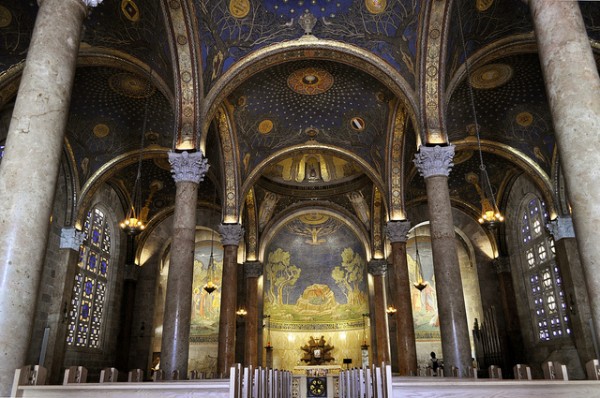
One of the most important contemporary monuments in Israel is located in the city of Jerusalem. Situated on the Mount of Olives, near the Gardens of Gethsemane, we find a Catholic temple that was formerly known as the Basilica of the Agony or Church of the Agony, although today it is more commonly named the Basilica or Church of All Nations.
This building was designed by the architect Antonio Barluzzi and erected from 1919 to 1924, through the financial contributions of several nations around the world. Prior to its construction, two churches had stood on that site. One from the Byzantine era of the 4th century (it was destroyed by an earthquake) and a 12th-century chapel, which was abandoned in 1345.
On the front structure of the building, we can appreciate the Byzantine style in the façade, supported by pillars. This is combined with a mosaic that symbolically depicts Jesus Christ as the link between God and Humanity. In fact, it is said that the church preserves a piece of rock where Christ was praying the night before he was arrested.
Inside, the nations that financed the construction of the church are symbolized in the stained-glass windows of the basilica’s ceiling, each in its own dome (up to 12 in total) and supported by six monolithic columns. This ceiling takes the form of bubbles and, together with the wide pillars and the mosaics, emphasizes the purely Byzantine style of the construction. The windows are made of bluish-purple alabaster, producing a distinctive and curious visual effect.
Today, the church is run by the Franciscans. Beside the temple, in an olive grove of unknown age, the Franciscans hold services on Holy Thursday, while in an altar located in the temple garden, the Anglican community holds services during Holy Wednesday.
A building that reflects part of the history of humanity, although its construction dates from a more contemporary era. Nevertheless, it is advisable to visit it during the period when ecclesiastical services take place, in order to see it in all its splendor.
Source | artehistoria
Photo | flickr-teterocamonde
2 comments · Comment
2 comments