The Seven Wonders of Portugal
Just as there are the Seven Wonders of the Ancient World or the Seven Wonders of the Modern World, one fine day the Portuguese Ministry of Culture decided that the Portuguese nation could also have its own list of Seven Wonders. And so, after several rounds of selection from Portugal’s heritage, and after a popular vote, the country chose its favourite monuments, its Seven Wonders. Would you like to know them? Then keep reading.
Guimarães Castle
Located in the city of Guimarães, the Castle is one of the most important monuments in the country, as it is considered the Cradle of the Portuguese Nation. It was built in the mid-10th century and restored not long ago to turn it into a tourist attraction that, by the way, can be visited free of charge, except for the Keep, for which there is an entrance fee. The Castle is not located within the historic centre of the city, but on its outskirts.
Óbidos Castle
The town of Óbidos is a coastal village that still looks like a fortified medieval town, and all of this is thanks to this Castle. The great medieval fortress originated in Roman times, was later used by the Moors and later by the Christians, after the definitive conquest of the town in the 12th century. Today, after a major renovation, it is a Pousada, that is, a hotel housed in a historic building.
Monastery of Batalha
Batalha is a town in central Portugal famous for this Monastery, which was selected among the Seven Wonders of Portugal. The Monastery of Batalha was built at the end of the 14th century, as an expression of gratitude to the Virgin for the “help given” to the Portuguese armies during a battle against the kingdom of Castile. The Dominican monastery, mainly Gothic in style, was later included on the UNESCO World Heritage List.
Monastery of Alcobaça
The Abbey of Alcobaça has the honour of being the first Gothic-style building to be erected in Portugal, back in the 12th century. This Cistercian monastery is also located in the Centro Region, in the town of the same name, and in it rest eternally some kings of Portugal, their wives and children. Entry to the church is free, although to walk around the whole monastery an entrance fee must be paid, which is currently 5 euros.
Monastery of Jerónimos
In the Lisbon district of Belém we find this spectacular Jerónimos Monastery, one of the main tourist attractions of the area. It was built in the 16th century to commemorate the successful return from a voyage to India of one of the most famous Portuguese navigators of the era, Vasco da Gama. Precisely here is his tomb, alongside those of other figures of Portuguese culture and of the royal family.
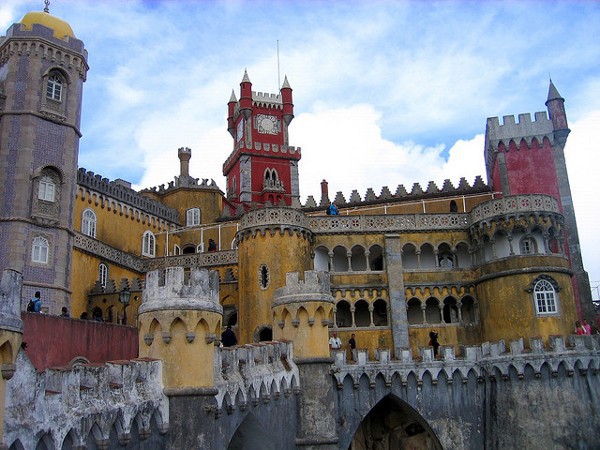
Pena Palace
The National Palace of Pena, or Palácio de Pena in Portuguese, is a huge palace perched on a rock, within the territorial limits of the town of Sintra, about 30 kilometres from the capital. It was built in the 19th century and was a royal residence in the summer months, so there is no lack of luxury inside or beauty in the gardens. If I may say so, it is a somewhat extravagant palace, due to the curious mix of architectural styles and its colourful appearance.
Belém Tower
To conclude the list of the Seven Wonders, we turn to the Belém Tower, one of the best-known and most visited monuments in Lisbon. This tower with a bastion was built in the 16th century right at the mouth of the Tagus, with the purpose of collecting taxes from those entering the city. Later it served as a lighthouse and as a prison, and now it is one of the city of Lisbon’s tourist attractions.
Photo | Flickr – Leoplus
4 comments · Comment
4 comments