The Abbey of Hagía María in Jerusalem
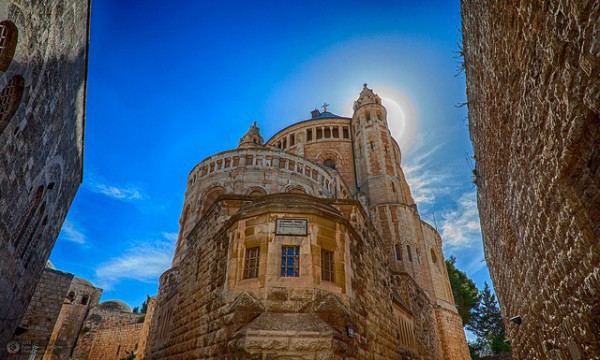
Without a doubt, Jerusalem is the ideal place to find monuments and buildings that are not only representative of Israel’s history but also carry a biblical symbolism that reaches the rest of the world. However, there are also other landmarks which, without being extremely ancient, can become highly representative of a place.
This is the case of the Abbey of Hagía María. It is a Benedictine abbey, built in 1910, located near the walls of the Old City of Jerusalem and the Zion Gate. It was traditionally known as the Abbey of the Dormition (glorification) of the Virgin Mary, although later, in 1998, it was renamed to its current name.
The site chosen for its construction also has its own history. In 1898, Emperor Wilhelm II bought the land on Mount Zion from Sultan Abdul Hamid II and donated it to the Catholic “German Association of the Holy Land”. Subsequently, the architect Heinrich Renard, of the Archdiocese of Cologne, carried out an investigation of the site in 1899, discovering remains of the Byzantine church of “Hagia Sion”, which in the end gave the abbey its final name.
Between 1918 and 1921, the first monks were sent to this land. During that period, they were also expelled. Initially, the building was established as a monastery until, in 1926, its ecclesiastical rank was changed and it became an abbey. Between 1939 and 1945, the monks were expelled once again, and a third expulsion took place in 1948, during the conflict between Arabs and Israelis.
Its structure is circular, with a variety of niches, inside which we find different altars and a choir. Within the abbey, we can access the underground crypt area, the organ, and the designated place where the Assumption of the Virgin Mary is said to have occurred. It is also possible to access, through a gallery, two of the four towers that were built. Inside, in the crypt area, we should highlight its Hungarian chapel, where the Virgin with the Child and various Hungarian kings can be seen. And in the main circular hall, there is a mosaic with three circles representing the Trinity.
An interesting place, no doubt. This abbey, which, as we said, is not excessively old (102 years) but holds within its walls part of humanity’s history, reflected in the Assumption of the Virgin Mary. An excellent chapter for all those interested in this part of history.
Source | wikipedia
Photo | flickr-juanramonjimenez
5 comments · Comment
5 comments