Elciego beyond Gehry's hotel: what remains of the traditional Rioja village
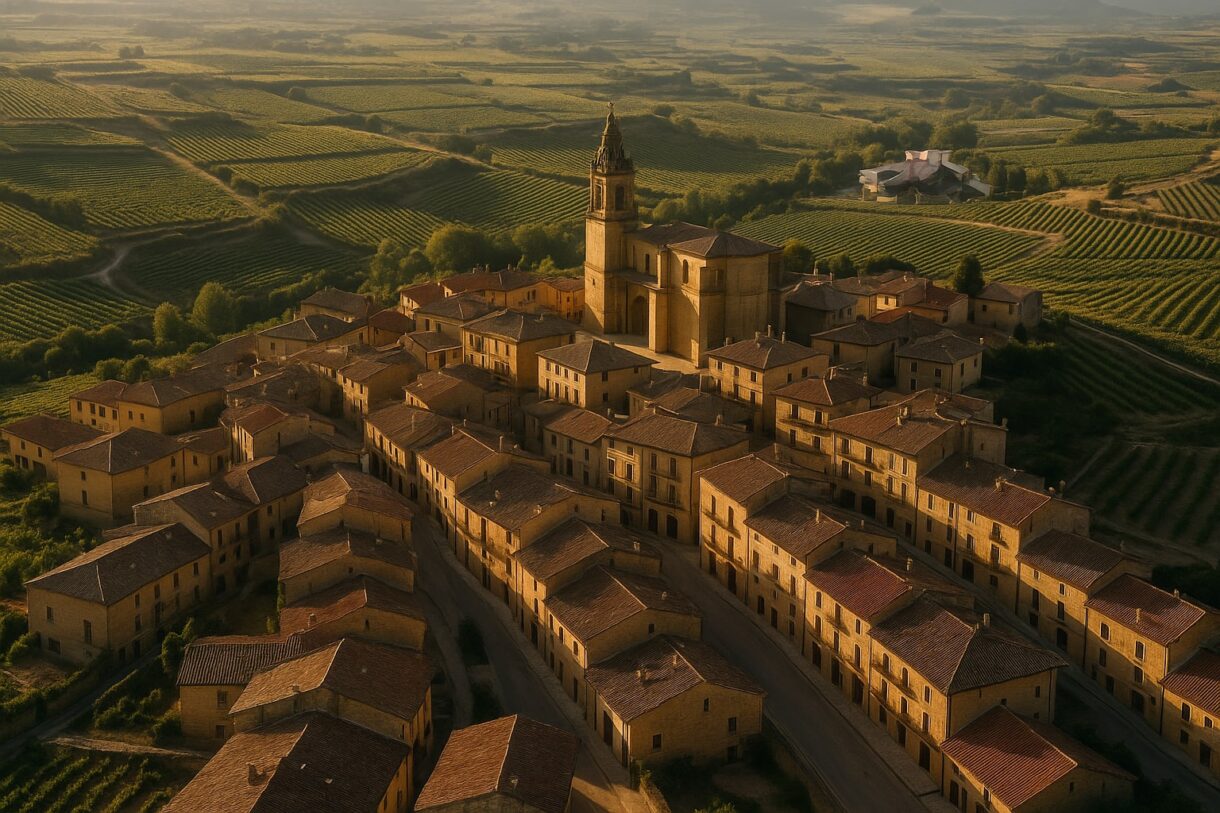
You arrive at Elciego by road from Cenicero and the first thing you see, before the village itself, is the pink, golden and silver panels of the Frank Gehry hotel. It is such a widely reproduced image that seeing it in person is almost disorienting, set among vineyards trained on trellises with the Sierra de Cantabria in the background. But if you stop at that postcard view, you miss the rest: a village of barely a thousand residents that had been making wine for centuries before anyone talked about star architecture.
This article is for anyone who wants to understand Elciego, Rioja Alavesa village for what it is: a medieval town perched on a hill, with a church-fortress, cellars carved beneath the houses and bars where people still order the chiquito. The hotel is part of the visit, of course. But it does not exhaust it.
Why Elciego matters (and not just because of Gehry)
Elciego belongs to the Laguardia district, in the Rioja Alavesa, the Álava strip of the DOCa Rioja wedged between the Ebro and the Sierra de Cantabria. The village has been documented since the 10th century, and its layout retains the defensive logic of a frontier town between Navarre and Castile. The Marqués de Riscal winery was founded here in 1858, one of the first in the area to introduce Bordeaux-style barrel-ageing methods.
The media breakthrough came in 2006, when the hotel designed by Gehry opened within the Riscal estate. Overnight, a farming village of fewer than a thousand inhabitants became a must-stop on the international wine tourism circuit. Almost twenty years later, the coexistence of these two worlds remains the most interesting feature of the place.
The old town: what to see on foot
Park in the lower part and walk up. The historic centre of Elciego takes a little over an hour to explore at a leisurely pace, and it is worth doing with the map provided by the town hall’s tourist office.
- Church of San Andrés: the building that dominates the village skyline. Begun in the 16th century, it has the look of a fortress thanks to its solid walls and a tower added in the 18th century. The baroque high altar is worth the stop; opening hours are irregular, so ask beforehand.
- Plaza Mayor and town hall: small, sloping, with arcades. This is where neighbourhood life gathers on Sunday mornings.
- Hermitage of the Virgen de la Plaza: the village patroness, celebrated in mid-September with the patron saint festivities, including palo dances.
- Underground cellars: beneath many houses in the old town are excavated cellars where families once made their wine. Some can be visited by arrangement with local wineries; the tourist office has an up-to-date list.
If this kind of walled town with underground cellars interests you, you will recognise the model we describe in Laguardia, capital of the Rioja Alavesa, about ten minutes away by car.
The Marqués de Riscal hotel and the City of Wine
The Marqués de Riscal City of Wine includes the historic 1858 winery, Gehry’s hotel, two restaurants and a wine-therapy spa. Guided winery tours cover the old buildings, the barrel room, the century-old bottle and a tasting of two wines. They last around 90 minutes and cost roughly €20-25 per person (check the official website before going, as prices change by season).
Entering the hotel without being a guest is not permitted beyond access to the restaurant or spa, both of which require a prior reservation. If you only want the exterior photo, there is a signposted viewpoint within the village itself that offers the most recognisable panorama: undulating titanium above the vines.
Eating and drinking in Elciego
In the old town there are a handful of bars where you can order a house crianza with a pintxo. The lamb cooked over vine prunings, roasted over the cuttings from vine pruning, is the flagship dish of the Rioja Alavesa; it is served in local grill houses and booking is advisable. Other local specialities: pochas (fresh white beans), nearby Navarran asparagus, and Idiazábal cheese from the Álava valleys.
For a more ambitious meal, the two restaurants at the City of Wine (one of which has held a Michelin star in various editions) operate in a different price bracket: tasting menus above €90-120 without wine pairing.
How to organise the visit
| Fact | Detail |
|---|---|
| How to get there | From Logroño, about 25 minutes by car. From Vitoria, around 1 hour. No train; limited bus service. |
| When to go | Spring and autumn (grape harvest in late September to October). Summer is hotter and busier with tourists. |
| Minimum time | Half a day for the village; a full day if you include a winery visit. |
| Parking | Free in the lower part of the village. |
If you stay overnight, using it as a base to also explore Laguardia, Labastida and the wineries of Samaniego makes more sense than coming just for a few hours.
What to take home
A bottle of crianza from a family winery in the village itself (not from the big brands), bought directly from its cellar. They cost between €8 and €15 and make a better memento than any souvenir. The next day, if you continue around the area, the walled town of Laguardia is the logical continuation; if you head north, Vitoria and its medieval old town round off the circuit nicely.
Frequently asked questions
Can you visit Gehry’s hotel without staying there? Only by accessing the restaurant or spa with a prior reservation. Common areas are reserved for guests. To see it from the outside there is a public viewpoint in the village.
How much does a visit to the Marqués de Riscal winery cost? Around €20-25 per person for the standard visit with a tasting of two wines, depending on the season. It is advisable to book in advance through the official website, especially at weekends.
What is the best time to visit Elciego? May to June and September to October. The grape harvest (last weeks of September and first of October) is the liveliest, but also the most in demand for accommodation.
Is it worth going with children? The historic centre is comfortable and small. Winery visits admit accompanied minors, although the content may feel long to them. For families, it is best combined with a walk through the vineyards.
How do I get there without a car? It is complicated. There are buses from Logroño and Vitoria with limited frequencies and timetables that leave little margin. The most practical option is your own car or a taxi from Logroño.
Places of Interest Leisure and Culture #arquitectura #Enoturismo #Guía de viaje #pueblos con encanto #Rioja Alavesa #Turismo rural


 Don't get fooled: plan your trip well and avoid these scams on your holidays
 Central Macedonia, the destination Spaniards have discovered to fall in love with Greece
 Summer in Brussels: flowers, festivals and typical gastronomy
Comentarios cerrados