Traditional Moroccan clothing
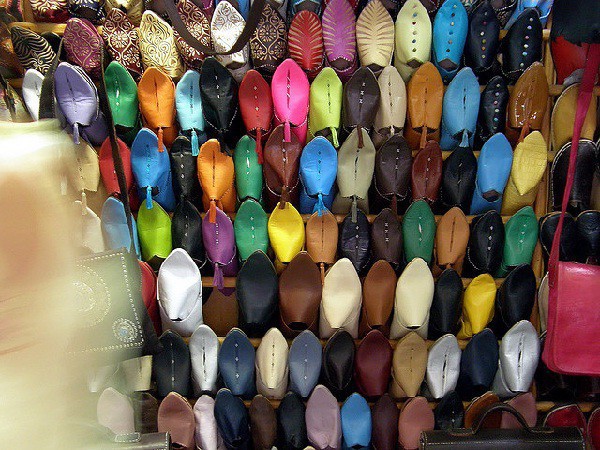
During our stay in Morocco we will be able to see how traditional Moroccan clothing is displayed and sold in most of the souks, forming part of the typical souvenirs. In fact, over the years the caftan/kaftan has grown very popular thanks to its use on special occasions by film and music celebrities. However, these garments are limited to special occasions for Moroccan citizens because of their high cost and their meaning.
Let’s take a brief tour of traditional clothing in Morocco. Let’s start with the feet: their best-known product is normally the babouches. A shoe that is open at the heel and ends in a point. It can be made of leather or plastic and decorated with different elements such as sequins and various colors. In any souk we can get a pair of babouches. Men usually wear this type of footwear, although among women it is also common to wear sandals consisting of two horizontal straps fastened with gold or silver buckles.
The most traditional headwear worn by men is the “tarbush” or “fez”, a cup-shaped cap that became very popular in the 19th century in Turkey and North Africa. It is traditional to the city of Fez, from which it takes its name. It is usually red with blue or black silk tassels. Women often wear scarves that cover their hair or simply adorn their necks.
The chilabas are unisex; they are tunics with two slits at the bottom. They can be made of different materials depending on the time of year they are worn. Women’s chilabas tend to be a little more fitted and feature more floral or striped decorations. Both have the hood as a common feature. Women normally wear it for its comfort and because it is a symbol of humility. Men usually wear it when going to the mosque to pray or on special occasions. Its daily use has fallen into the background in the big cities, although this is not the case in villages or less touristy places.
And finally the caftan, which differs from the chilaba because it has no hood, although it is also a multi-layered tunic. It is usually worn on special occasions such as weddings. It is a garment that involves great artisanal craftsmanship. A wide variety of fabrics can be used to make it, such as silk, cashmere, taffeta or velvet. The embroiderers then add wonderful touches with gold and silver threads. Finally, the passementerie work that completes the garment provides the caftan with loops, buttons, braids and trims.
Source | Wikipedia
Photo | Flickr-Jrgcastro

4 comments · Comment
4 comments
Definitivamente todo lo que publican es diferente, por ello los seguimos. Los felicito.
los mejores productos marroquís los encontraras en ,la autentica”..te asesoran y tienen unos productos excelentes..