Carnival of Papalotla de Xicohténcatl
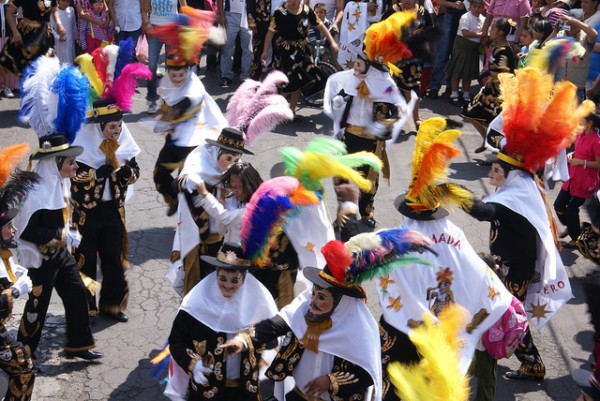
This site is located on the Mexican Plateau at 2,200 meters above sea level, in the south of the state of Tlaxcala. The municipality of Papalotla de Xicohtencatl borders Acuamanala de Miguel Hidalgo, Mazatacochco de José María Morelos, and Tenancingo, Puebla, and Xicohtzinco.
The carnival held in this region is internationally recognized. It is an event in which religious syncretism between Catholicism and Mesoamerican religiosity is evident. During the carnival festivities, two different dances can be seen, both displaying rich symbolism from a very interesting culture. The dances are: the Muñeca (the Doll) and the Culebra (the Snake).
The Muñeca has its origins in the Mesoamerican past of the Nahuas who inhabited the areas around the Malinche volcano. In that place, the water goddess Matlalcueyetl and the Child God were fundamental parts of the religion.
The Culebra dance is more closely linked to the mythical past of the area. In it, the main character, called Malinche, has the ability to transform into a serpent woman.
Before the Spaniards arrived, the inhabitants carried out various rituals in which they asked for rain to improve the harvests, as well as various agricultural rites that coincided with the months of Atlcahualo and Tepeilhutl (corresponding to the Mexica calendar). At that time it was believed that through these rituals a good climate could be achieved. When the Spaniards arrived, a new stage of evangelization began which, among other things, sought to eradicate the various pagan practices.
Over the years, the European carnival was gradually introduced to Tlaxcala, and the indigenous people saw in the celebrations a way to carry out their rituals without facing ecclesiastical punishment.
Today, the carnival takes place on the Sunday, Monday, and Tuesday before Ash Wednesday. Furthermore, the second, third, fourth, and fifth Fridays after the start of the carnival the festivities continue, extending into the Lenten season, where notions of modesty and spirituality must be balanced against the desire to transgress and the chaos present in the carnival.
Source | Wikipedia
Photo | Flickr – Mark Morris

3 comments · Comment
3 comments