Derry or Londonderry
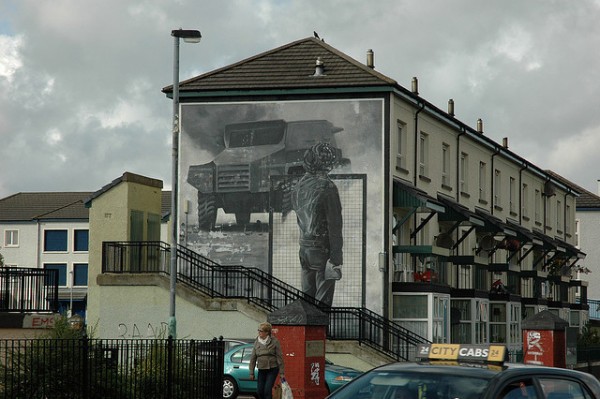
Derry is an Irish city that many know as Londonderry, in Irish Gaelic Doire or Doire Cholm Chille. Although it initially occupied only the west bank of the River Foyle (in Northern Ireland), today you can visit it on both banks of the river. To cross it, you can use one of the three bridges, the third recently inaugurated under the name Peace Bridge.
The name of this city is controversial: since 1613 it has officially been called Londonberry, and that is how it appears on maps, but locals call it Derry.
Derry has a population of around 110,000 people. It is the second largest city in this region of the country and the fourth in all of Ireland. In his time, Charles II tried to restore the rights of Catholics. The Irish wanted to drive out the Protestant farmers, so to avoid this, the farmers went to live in Derry (the name the pro-Irish Catholics gave it at the time) or Londonderry (what the pro-British Protestants called it).
When William of Orange deposed Charles II, Irish Catholics were punished and stripped of basic rights, such as the right to work or to have Catholic schools.
The area was the setting for another historically significant event. In 1969, during the Battle of the Bogside, some of the riots took place in the Bogside district of Derry. This was the beginning of a series of social disorders that ended with the creation of a self-proclaimed autonomous area.
The Catholic neighborhoods of the city are: Creggan, Bogside, Shantallow, Carnhill, Culmore, Ballymagroarty and Gobnascale. The Protestant neighborhoods are Irish Street, Nelson Drive and Kilfennan. Unfortunately, even today there is great rivalry between them.
Source | Wikipedia
Photo | Flickr – Carlos El Hormigo
1 comment · Comment
1 comment